The Ultimate Guide for Artivists to Uncover Your Artistic Style and Voice

Welcome to this ultimate guide to mindset for artivists, which will include:
Part 1: The Difference Between Style and Voice
Part 2: Personal Symbols
Part 3: Aesthetic
Part 4: Vision
Part 5: Your Unique Edge
Part 6: How to Integrate Your Style and Voice
Let’s dive right in!
Part 1: The Difference Between Style and Voice
Uncovering and developing your artistic style and voice along your artivism journey is a deeply personal experience that combines self-exploration, experimentation, and reflection. That’s what we’ll be focusing on in this post.
But first, in this first section, I will focus on the difference between style and voice because I often see them mixed together and confused.
Without further ado, let’s dive in!
The Difference Between Style and Voice
The terms “style” and “voice” are often used interchangeably in the creative fields, but they refer to two distinct, though closely related, concepts.
Let’s begin by looking at some general aspects of style and voice, respectively.
Style
Style refers to the aesthetic choices and frameworks you use in your creative work. It’s your personal aesthetic and what you find beautiful or captivating. It also includes your process, technique, and execution.
Style could include:
Mediums
Techniques
Genres and tropes
Color palettes and textures
Structures and compositions
Use of metaphors and symbols
Etc.
In other words, style is the “how” of your work.
I will give you some examples of works of artivism below to show you how style can be used.
Voice
Voice refers to your work's underlying expression, message, perspective, and unique, personal marks. It reflects your personal perspective, thoughts, emotions, and worldview, to name a few things.
Voice includes:
The deeper meaning behind what you create
The themes and stories you express through your art and why
Your purpose and message
Your values
Etc.
In other words, voice is the “why” and “what” of your work.
Examples
Now, let me give you some examples to illustrate the difference between style and voice.
The Metropolitan Museum Poster by Guerrilla Girls
Guerrilla Girls is an anonymous group of female artists who bring awareness to the sexism and racism within the art world. They’re known for staging surprise exhibitions and hanging up posters in public spaces to spread their message.
Their most iconic poster is the Metropolitan Museum poster from 1989, which states: “Do women have to be naked to get into the Met. Museum?” with the Grande Odalisque by Ingres as the template for the naked woman with the gorilla mask on the poster.
The yellow background, depiction of at least one woman, and the informational text on their artworks were part of their style (which has developed a bit since then).
The voice of the work was the text, and how it was made as a response to the overwhelming number of female nudes in the modern art sections of the museum, compared to the very few works by female artists that were exhibited there.
A lot more can be said about their use of one of the most famous female nudes in Western art (Grande Odalisque by Ingres), putting a gorilla mask as their signature over her head, etc. But you get the point.
B.Y.O.B. by System of a Down
System of a Down is an American-Armenian metal band with several songs that are activist in nature. B.Y.O.B. (from 2005) in particular was written in protest against the Iraq war and includes the powerful lines: “Why don’t presidents fight the war? Why do they always send the poor?” and “You depend on our protection, yet you feed us lies from the tablecloth”.
The style is the genre of music, in this case, it’s metal. They also have their own specific style of tempo changes that are sudden, yet transition seamlessly between each other through the song (and most, if not all, of their other songs).
The voice is their strong message against the Iraq War and the title of the song in itself, B.Y.O.B., which here means “Bring Your Own Bombs”.
I hope this gave you a clear idea of the difference between style and voice and in more than just one creative discipline and art field.
We will explore both of these topics more below as we’ll dive deeper into ways that you can identify your own personal style and voice and how to integrate them into your work.
Before I end this introductory section, however, I want to highlight the importance of documenting your journey.
Keep a Logbook
Uncovering and developing your style and voice takes time. It’s a self-discovery, experimental, and contemplative journey. To make the most out of it, I recommend that you keep a logbook of sorts. You can use a physical notebook or a digital one. Use what works for you.
However, it’s important that you can access it regularly, especially on the days you do creative work.
The things that are beneficial to jot down every day you’ve done creative work are:
Influences and inspirations of that day
How your creativity and work of that day made you feel
What you liked or are most proud of, and what you didn’t like about your work that day
What lessons you learned
Your progress on your current project/projects
Etc.
Keeping a logbook will help you recognize patterns that can inform you about your style and voice. It can make this process a lot easier.
Also, keeping a logbook is a great way to document your creative journey, to see the growth you’ve made over time. It’s easy to forget where we’ve been, but it’s also so important to remind ourselves of our growth and progress because it can cultivate joy, excitement, motivation, and confidence, all of which are fuel to keep going and create more amazing work on your artivism journey.
Part 2: Personal Symbols
In this second part of the post, we’re jumping into some creative exercises that will help you identify your personal symbols.
Why symbols, though? Well, symbols are a vital component of human expression. They represent something beyond their literal meaning. Personal symbols can emerge as visual motifs, themes, or recurring images that represent deeper aspects of your inner world or the message you want to communicate. Symbols can represent your emotions and beliefs about a certain topic, experiences, unresolved conflicts, and more.
Personal symbols can also offer a type of language to express things that words alone can’t. These symbols can be used in any type of creative work you do, from painting to writing to music or knitting. In anything, really.
This section is inspired by Carl Jung’s work on symbols, archetypes, and the unconscious mind. I’m definitely not an expert on his work; this lesson is only inspired by some of the things I remember from what I learned in school. So, if you’re interested in learning more about this, I recommend exploring his work further.
But, to summarize, Jungian psychology suggests that symbols emerge from the unconscious and can, therefore, be highly personal. These symbols often carry meanings that are specific to an individual's life experiences, perspectives, and psyche, which is why exploring them can enrich your artistic voice and help you develop your unique style as an artivist. Exploring your personal symbols has the potential to add deeper layers of meaning to your work. That sounds pretty cool, doesn’t it?
But what are personal symbols, and how can we identify them? Let’s start by looking at what personal symbols are before I give you some fun, creative exercises.
Personal Symbols
As mentioned, personal symbols are recurring images, shapes, motifs, or themes that you notice and are drawn to. They can show up:
In your work
In movies and shows you like
In your dreams
You can notice them in the world around you
Etc.
They often have a significant meaning to you, but that meaning might initially be obscure. Which personal symbols that show up for you can also depend on things like:
Your life experiences
Memories
Emotions
Cultural background
The geography of where you grew up
Your relationships with family and friends
Your relationship with the natural world
Etc.
Personal symbols can also manifest in many different forms. They can show up as:
Animals
Numbers
Colors
Objects
Abstract shapes
Natural elements
Etc.
When I explored my own personal symbols in a project at school several years ago, birds often showed up in my work, especially smaller, colorful birds. At first, I had no idea what deeper meaning they had to me, other than that I thought they were beautiful. But as I explored it further and looked into their symbolism, I realized that it was about freedom. It was about breaking free from the cage I felt like I was living in. Since then, I’ve always been interested in birds, and they’ve often shown up in my work, especially in my writing.
In other words, these symbols often act as a language that speaks directly from your inner world. You might not know the message or deeper meaning of your symbols at first, but becoming aware and learning more about them can help you interpret their meanings. And if they resonate deeply with you, you can then use them in your work to make your work more meaningful, authentic, and aligned with your style, voice, and the message you want to communicate.
So, let’s move on to some creative exercises that will help you explore your own personal symbols. Only do the exercises that resonate with you and that you feel called to do, and then leave the rest.
Identify Your Symbols
Explore Your Dreams
The first exercise is to explore your dreams. And by dreams, I mean the ones you have while sleeping.
Exploring the dreams you have while you sleep, in particular the symbols you notice and remember, is a great way to discover symbols buried deeper within your subconscious. The symbols that show up in your dreams are, therefore, often rich with personal meaning.
Here’s what you can do:
Keep a dream journal for the next week or two and write down your dreams as soon as you wake up. Try to record as many details as possible. You can note down specific objects, places, people, or emotions that stood out to you.
After you’ve recorded your dreams for a week or two, review your notes and look for patterns in the form of recurring symbols or images. Your symbols might show up in different forms or in different contexts in your dreams. For example, time might show up as a clock in one dream but a change in seasons in another.
Once you've identified one or several recurring symbols, pick one and take some time to reflect on what that specific symbol might represent. You can do that by asking yourself:
What emotions or memories does this symbol evoke in you?
What does it symbolize in a general sense? (e.g., snakes can symbolize transformation, the color blue can symbolize peace, trees can symbolize wisdom, etc.)
Has the symbol appeared in past dreams or creative works you’ve made?
How might the symbol relate to your past experiences?
How might the symbol relate to the causes and social issues you want to bring awareness to? Or, in contrast, does the symbol reveal what kind of social issues you want to bring awareness to?
How might the symbol relate to your current life and work?
If you, for example, notice the recurring image of a lion showing up in your dreams, consider the lion’s qualities (e.g., strength, courage, leadership) and how these may be relevant to your artivism.
Now, let’s move on to the next exercise.
A Collage of Personal Symbols
This exercise is about finding symbols that resonate with you on a deeper level and making a collage out of them.
This exercise is more about seeking out symbols rather than letting them come to you, as we did in the previous exercise. In this one, we’re letting our intuition guide us to collect the images that resonate with us, so we’re still using our inner guidance system in this exercise.
This exercise also has a 3-step process:
Start by collecting images from magazines, newspapers, old photographs, and other found materials. The aim is to create a collage of images that resonate with you. You can also look at your Pinterest boards if you have one where you collect images that inspire you. Don’t overthink this process. Let your intuition guide you as you look for images and symbols and collect the ones that resonate with you.
You can choose to make your collage in a sketchbook or on a bigger piece of paper or board. If you want to do it digitally, that’s fine too. Do what works best for you and use what you already have available.
Then let your intuition guide you as you put together the collage. You may want to test a few compositional alternatives before you paste/pin them down to create a certain aesthetic or vibe. It’s okay if you don’t use all the images you collected or if you feel like you need a few more to complement the collage. As long as you end up with a collage that resonates with you.
As you work on the collage, notice if certain types of images appear more frequently. Maybe it’s images of eyes, animals, geometric shapes, or numbers. It can also be a certain vibe or color scheme that shows up as a pattern.
Reflect on and analyze the symbols after completing the collage. Take a step back and analyze it. If you want, you can come back to it in a couple of days to get an even fresher perspective on it. Then ask yourself:
What symbols stand out the most to you?
What do they symbolize in a general sense?
How might these symbols relate to your past experiences?
How might the symbol relate to the causes and social issues you want to bring awareness to? Or, in contrast, does the symbol reveal what kind of social issues you want to bring awareness to?
How might these symbols relate to your current life and work?
Symbol Mapping
The third exercise is similar to a mind map where you dive deeper into your life experiences to identify significant symbols.
Here is the 3-step process:
Begin by drawing a circle in the center of a piece of paper. Write something that represents you in that circle (it can be your name or a phrase that represents you). Then create branches around that circle that represent significant moments in your life. This can include childhood memories, pivotal life events, topics that you feel very strongly about, etc.
For each key moment or experience from your past that you’ve written down, draw or write symbols that come to mind. These are symbolic representations of your experiences. Your symbols can be literal representations (e.g., the image of a house representing your childhood home) or more abstract representations (e.g., a storm for a turbulent time in your life).
Reflect on and analyze your map to identify recurring themes. If you want, you can come back to it in a couple of days to get an even fresher perspective on it. Then ask yourself:
Are there symbols that repeat or seem particularly significant?
What do these symbols mean to you?
What do they symbolize in a general sense?
How might the symbol relate to the causes and social issues you want to bring awareness to? Or, in contrast, does the symbol reveal what kind of social issues you want to bring awareness to?
Have these symbols appeared in past creative works you’ve made?
How could you use them in your creative work going forward?
Reflecting on Personal Symbols in Your Work
The last exercise I’ll share in this section of this guide is to keep exploring if any of the symbols that showed up in these exercises have shown up in your creative work. Think about, or look at, your work and ask yourself:
Do any of these symbols you’ve discovered appear in your creative work?
Have these symbols evolved over time, or have they stayed consistent?
How do these symbols enhance or deepen the meaning of your work?
Do they bring awareness and/or strengthen the message you want your work to communicate?
Do you like how you’ve used them?
Do you want to change how you use them from now on?
What other symbols that you’ve discovered in these exercises do you want to use in your work?
How can you use them in your work?
What deeper meaning would they bring to your work?
Would they help you strengthen your message and/or the topic(s) you want to bring awareness to?
A Few Additional Words
As you go through the exercises in this section, I want you to remember that personal symbols often evolve as we grow and change, so don’t worry if your symbols shift or transform as you continue on your creative journey. What you discover here isn’t set in stone, but the symbols can be very powerful to explore nonetheless.
Understanding and incorporating your personal symbols into your creative work can help you express your inner world and message more authentically. Symbols give your work layers of meaning and emotional depth, which can also help you create a more powerful connection with your followers and community. Over time, these symbols can become key elements of your work that make it stand out and look uniquely yours.
I also want you to remember that the process of identifying and developing personal symbols is ongoing. Coming back to this section and the exercises regularly can help you stay connected to your personal style, voice, message, and work. And that’s really powerful.
Part 3: Aesthetic
In this third part of this ultimate guide, we’re jumping into some creative exercises that will help you identify your artistic aesthetic.
Usually, aesthetic is reserved for the visual media. However, what I teach in this section will also benefit you if you, for example, write stories or lyrics. In the literary field, you can look at aesthetics as your descriptions, metaphors, and other imagery rather than the actual colors, marks, or forms used in visual media.
Exploring your aesthetic is a fun and important part of any creative’s journey. It can help you define your unique style, which can give your art a recognizable identity. It’s almost like your personal trademark or artistic fingerprint, which makes your work recognizable as yours.
So, let’s dive into what I mean by your aesthetic and why it’s important to explore and identify.
Your Aesthetic
What is an Aesthetic?
Your aesthetic is essentially the visual language, vibe, and emotional tone that runs through your work.
Within a visual medium, it can be the unique combination of colors, forms, textures, symbols, and the overall mood that you create in your work.
Within the written word, it can be your descriptions, symbols, and other forms of imagery you choose to include in your work.
A personal aesthetic is basically the essence of your creative identity, which is shaped by your influences, what you find beautiful, your values, experiences, and interests, to name a few things. Again, think of it as your personal artistic fingerprint.
Why is an Aesthetic Important?
One of the reasons it’s important to explore and identify a personal aesthetic is that:
It gives your work a creative direction and cohesion. This is especially important if you work on a series or a collection where you want a certain cohesion (e.g., a series of pieces that bring awareness to one and the same cause or social issue/injustice).
Also, if you’re a multidisciplinary creative, having a clear aesthetic makes it easier for your audience to identify your work, regardless of what you create.
And, it can also help you with your branding as you put your work out into the public eye.
Now, let’s move on to some creative exercises that will help you explore your own aesthetic. And, as usual, only do the exercises that resonate with you and that you feel called to do, and then leave the rest for now.
Identify Your Aesthetic
The Things that Stand Out to You
Before you can fully understand and/or visualize your aesthetic, you need to acknowledge the things you find beautiful, the things that move you, and the things that pique your interest.
The fastest and easiest way to do this is to create a secret board on Pinterest and pin every image that stands out to you onto that board. It can include:
All the elements of art (for example, color, line, form, light, texture, contrast, composition, etc.)
Animals
Landscapes/cityscapes/seascapes
Architecture
Design
Portraits
Food and drinks
Etc.
A fun way to go about this is to try and include all the senses:
What do you find beautiful to look at?
What do you enjoy listening to?
What smells do you like?
What do you love to eat and drink?
What textures do you like to touch?
Then, when you have around 40-50, or more, images on that board, you can start looking for patterns and commonalities.
Map of Influences
Another fun way to explore your aesthetic is to dive deeper into the art that influences and inspires you and your work. We’ll be doing that by collecting images to create a map of influences, which you will reflect on when you’re done.
Start by collecting images. Examples of what images to collect:
Artists: Who do you admire? Which artists have influenced you? This can include painters, sculptors, musicians, photographers, fashion designers, filmmakers, graphic designers, and more.
Movements: Are there specific art movements or trends that you resonate with or that you find captivating/beautiful? This could be movements and trends in different artistic disciplines.
Colors and shapes: Do you find yourself drawn to specific color palettes or shapes? What colors and shapes seem to repeat in your work?
Surroundings: Is there a particular landscape, cultural reference, or environment that inspires you? How about architectural features, weather conditions, and smells?
Personal experiences: What life experiences or emotions do you often channel into your creative work? What life experiences or emotions do you want to channel into your creative work?
Personal symbols: What were the symbols you discovered in the previous section in this guide? Did any of them pique your interest? Would you like to incorporate them into your work?
Pick out your favorite images and the ones that resonate the most with you. Paste them into a sketchbook, on a separate piece of paper, or make a digital map with them. The goal is to build a map of references and inspirations that contribute to your artistic style.
Reflect on the map you’ve made:
What is it that you’re so drawn to when it comes to each image? What about them piques your interest and curiosity?
Look for patterns. What do these influences have in common?
Are there any common color schemes, vibes, emotions, motifs, marks, etc.?
What about them would you love to add to your own work?
When you’re done, you have a map of influences that you can combine in your own work. The more sources you have, the better, because combining ideas from different sources in your own work will help you avoid the risk of copying the works you love.
Define Key Elements of Your Aesthetic
In the third exercise, we will look at your work and define key elements of your aesthetic. Looking closely at the work you’ve already created can give you insight into what you naturally gravitate toward, even if you haven't consciously defined it yet.
By looking at your own work, you can begin to distill the key elements of your personal aesthetic. These elements are the building blocks of your unique style.
I would recommend that you use this exercise for one discipline at a time if you create work in several disciplines. Then, if you’ve chosen to do this exercise with more than one discipline, you can compare the results with each other and look for similar patterns, if that feels like something you would want to do.
But, for now, select some of your most recent work, perhaps it’s three books, five poems, ten paintings, or something else. Then look for the bigger recurring patterns, themes, and imagery, as well as the smaller details you use. You can ask yourself:
What are the dominant themes in your work? How do you depict those themes?
Are there specific symbols or imagery that appear in your work?
What are the dominant colors and textures in your work? How are you using them?
Do you prefer warm or cool tones?
Do you prefer bold and saturated colors or more muted and desaturated ones?
Do you prefer smooth and glossy surfaces, rough and textured ones, or something in between?
What kind of shapes and forms do you use?
Do you use geometric shapes, organic forms, or a combination of both?
Is your work more representational or abstract?
What’s the dominant vibe or mood? How have you depicted and enhanced that mood?
What kind of themes have you used to enhance the mood?
What kind of colors have you used to enhance the mood?
What kind of textures have you used to enhance the mood?
What kind of words have you used to describe the mood?
What emotions does your work depict? How have you succeeded in depicting that?
What kind of themes have you used to enhance the emotions?
What kind of colors have you used to enhance the emotions?
What kind of textures have you used to enhance the emotions?
What kind of words have you used to enhance the emotions?
What media and techniques do you use the most?
By identifying these elements, you can start to create a clearer picture of your personal aesthetic.
Refine Your Aesthetic
Now that you have a better idea of your influences and what aesthetic your recent work has, the final exercise will help you refine your aesthetic.
This exercise builds upon the previous ones. However, you can do this one if you’ve done only one of the previous exercises as well.
The core of this exercise is basically to take what you’ve discovered in the previous exercises and reflect on how you can use that in your work going forward.
Journal on the following questions (and keep the subject matter of your artivism in mind as you reflect on this):
What are the themes you want to include in your work? How can you depict them?
What are some specific symbols or imagery you want to include in your work?
What are some colors and textures you want to include in your work?
What kind of shapes and forms do you want to use?
What kind of vibe or mood do you want your work to have? How can you depict and enhance that mood?
What kind of themes can you use to enhance the mood?
What kind of colors can you use to enhance the mood?
What kind of textures can you use to enhance the mood?
What kind of words and descriptions can you use to enhance the mood?
What emotions do you want your work to depict? How can you depict and enhance those emotions?
What kind of themes can you use to enhance the emotions?
What kind of colors can you use to enhance the emotions?
What kind of textures can you use to enhance the emotions?
What kind of words and descriptions can you use to enhance the emotions?
What media and techniques do you want to use in your work?
What type of subjects do you want to depict?
How can you make sure your aesthetic works well with your subject?
How can you make sure your aesthetic works well with the message you want to communicate?
A Few Additional Words
As you continue your creative and artistic journey, remember that your personal aesthetic is not static. It will continue to evolve. So come back to this section whenever you want to update yourself on your aesthetic or if you ever feel stuck or lost in your creative work.
Part 4: Vision
In this part of this ultimate guide, we are doing some fun dreaming and envisioning to help you identify your vision for your creative work and artivism.
But before we dive into the exercises, let’s define what I mean by vision.
Vision
What Do I Mean by Vision?
Every artist or creative has a unique perspective shaped by their experiences, worldview, and influences, to name a few fundamental things. That unique perspective, in turn, influences:
The vision you have for your creative work and artistry
What you want to create
The message you want your work to communicate and stand for
What you want it to look like
Etc.
In other words, your vision is the common thread that connects your work together.
Just like the other parts we’ve covered in this mini-series so far, your vision will also evolve as you continue your creative journey and create more work. It’s an ongoing process where you might benefit from consistently returning to these exercises.
And speaking of the exercises, let’s get into them. As usual, only do the exercises that resonate with you and that you feel called to do, and then leave the rest.
Identify Your Vision
Journaling Prompts
I first recommend that you do some simple journaling on the vision you have for your work. You can journal however you want. If you prefer to do it in a mind-map kind of style, that’s great too.
Here are the questions:
Message: What do you want your work to say? What message do you want your work to communicate?
What issues, themes, or experiences do you feel drawn to explore in your work?
What emotions or human conditions would you like to explore?
What social issues and injustices or movements do you want to focus on in your work through your messaging, themes, subject matters, etc.?
Style: What do you want your work to look and feel like?
What media do you want to use? What media are required to get the look and feel you want?
You can pull ideas from the previous sections where we explored personal symbols and aesthetic, which can both influence your style.
Purpose: Why do you want to create what you want to create?
What impact do you want your work to have on your family, your community, or the world?
If you haven’t already explored your reasons behind why you’re an artist, artivist, or why you want to create art for social change, you can explore the post about uncovering your “why” and pull ideas from the exercises there.
Aspirations: How far do you want to go and reach with your work?
What does success look like to you?
Which artists or artworks have the success you want to have? What do you think it would feel like to reach that kind of success?
Pull ideas from the section about aesthetic, especially the exercise on exploring and making a map of your influences.
If there is one exercise I recommend you do in this section, it’s this one. Reflecting on and writing down your vision will benefit you a lot.
Clarify Your Vision, Message, and Purpose
The next exercise builds upon the previous one. Here, I want you to write a vision statement that defines what you aim to express through your art. This statement should reflect your vision, message, and the purpose of your work.
The key to remember is that your vision statement should be clear, concise, and something you can return to as you continue your creative journey.
Just like the other things we’ve gone through in this ultimate guide, your vision statement can evolve as well. Look at it as a reminder of what drives you and your work right now. You can always change it when needed.
Here are two template examples you can use or tweak to fit your own needs:
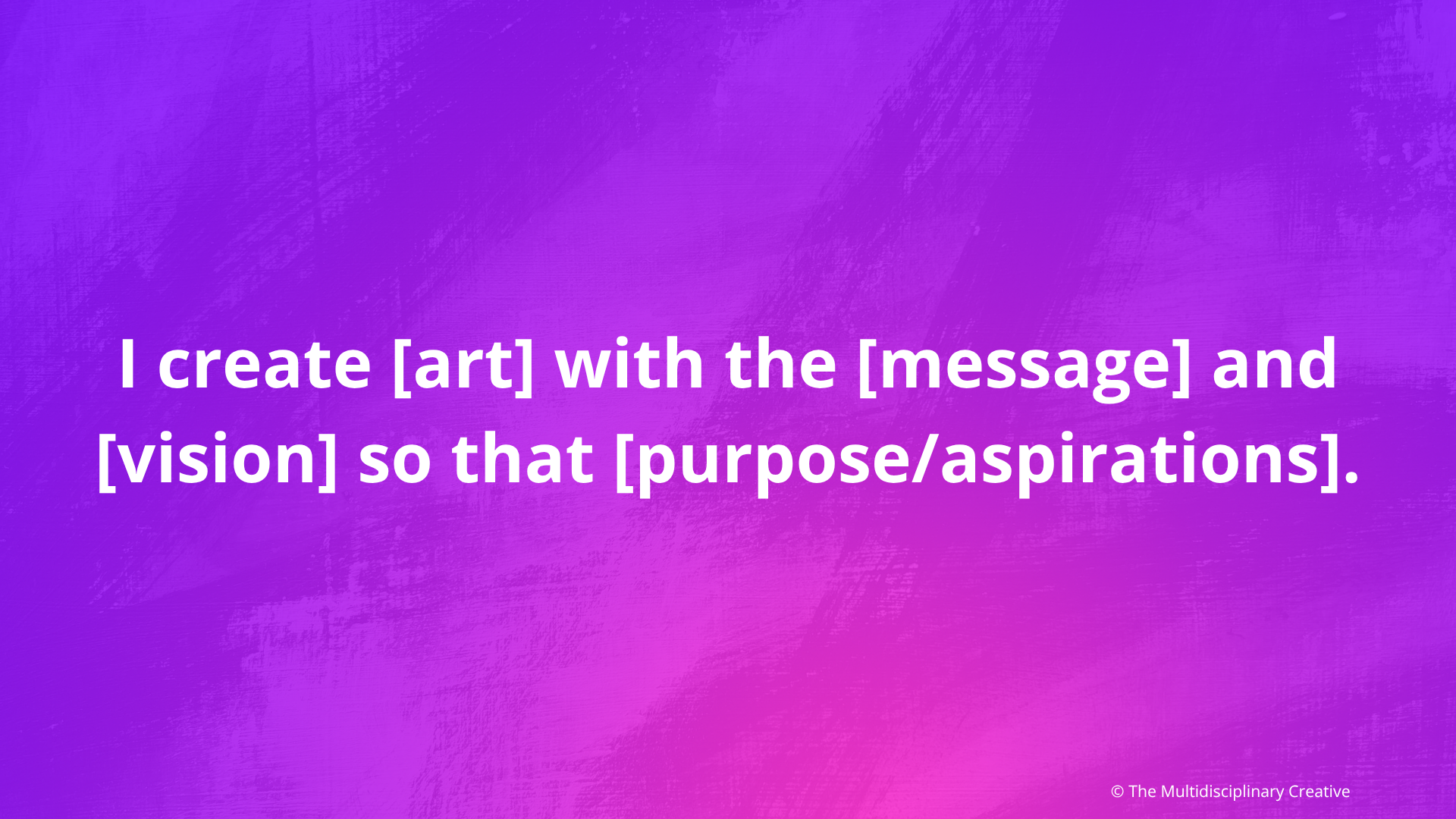
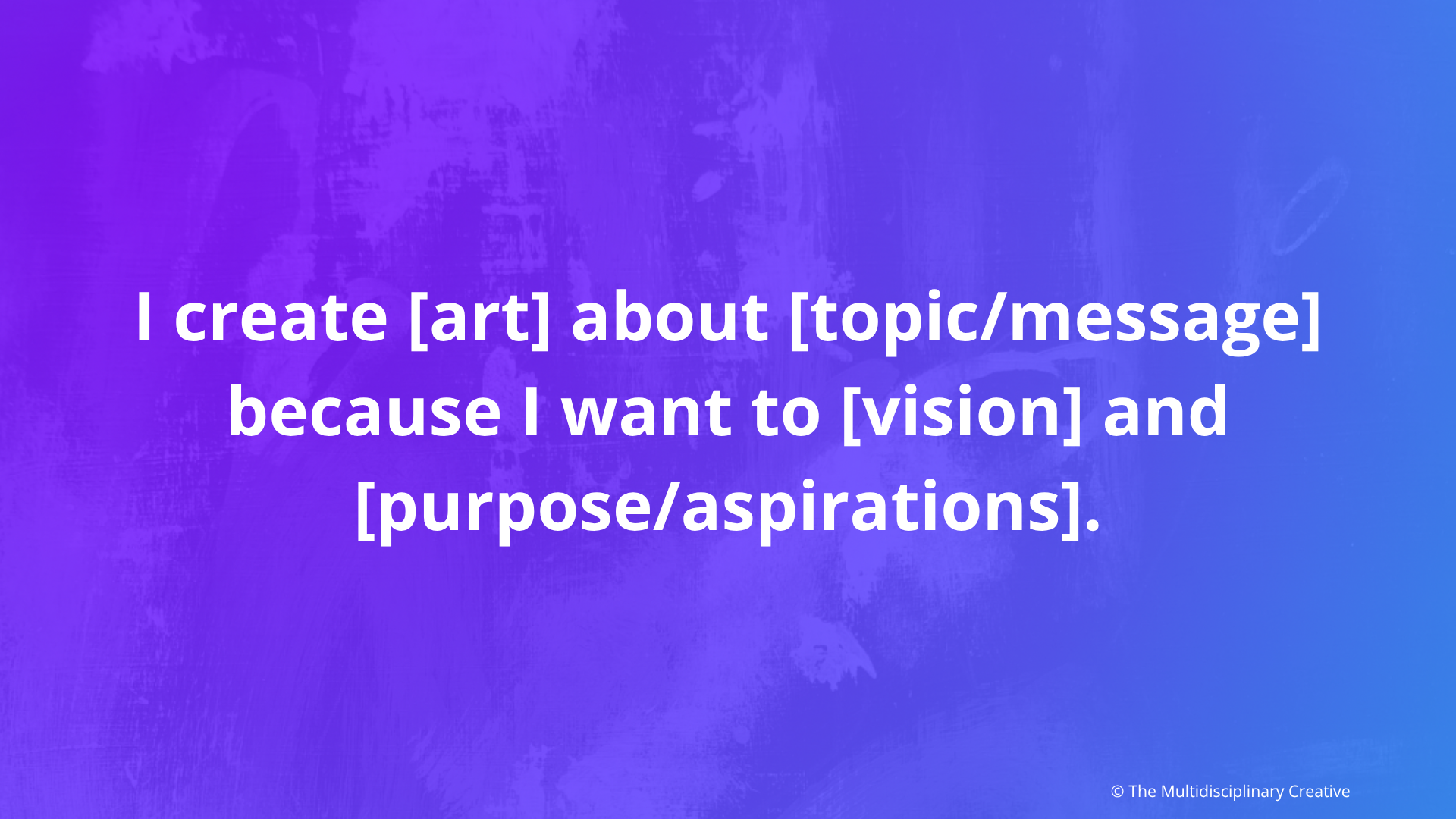
A few examples of this could be:
“I use plastic found on my local beach to create sculptures of the sea life affected by the pollution and communicate the damage plastic does.”
“I write essays about intersectional feminism to be inclusive and educate on the complexities and importance of the topic.”
“I create abstract art with contrasting colors and gold leaf to show that our cracks are where the light enters. I want my art to represent the healing and hope we all need more than ever.”
You might need to write a few of them before you settle on one that resonates with you.
When you’re done, write it on another piece of paper or print it out and put it somewhere you can see it every day.
Explore Your Vision Through Experimentation
The last exercise in this section will take some more work because I want you to explore your vision through experimentation.
While theory and reflection are crucial, putting your vision into practice through your creative work is essential too. Experimentation allows you to uncover new aspects of your voice, explore your message, and refine your vision, to mention a few things.
So, what I want you to do in this experimental exercise is to:
Create a small body of work. It can be a series of smaller paintings, a couple of poems, a couple of story outlines, a series of thumbnail sketches, or something else.
The only requirement is that they ideally should reflect the ideas, emotions, messages, and themes you’ve identified through the previous exercises.
As you create, keep your vision statement in mind and try to incorporate elements from the exercises you may have done in the previous sections as well, for example, the sections on personal symbols and aesthetic.
As you create, focus on expressing your vision as authentically as possible.
If you’re not sure about your vision or what you want your art to express, you can also use this exercise as a way to let your creative process reveal what is true for you right now.
When you’re done with this smaller body of work, it’s time to reflect on what you’ve created from the lens of your vision:
What aspects of the pieces feel most aligned with your vision?
How did you incorporate your vision, message, and purpose in your work?
Does the work look the way you wanted it to look? Does it feel the way you wanted it to feel?
What surprises or new insights emerged during the creation process?
Since this experimentation exercise might take some time to work on and explore, I recommend that you do it on the side of your primary creative work. You can see it as a hobby, a side project, or as a self-discovery practice.
Also, if you happen to create ugly art in the process, that’s fine. You might even want to explore this intentionally by making ugly art for experimentation and exploration. It might even lead to some great creative breakthroughs.
A Few Additional Words
As I’ve mentioned already, identifying your vision is an ongoing and evolving process. It’s normal for your vision to change over time as you grow as an artist and creative. The key is to embrace this evolution rather than forcing it into a confining box. You can always come back to this section whenever you feel called to reflect on your vision.
Part 5: Your Unique Edge
In this fifth part of this ultimate guide, we are going to explore your edge and what makes your creative work and artivism explicitly and uniquely yours.
But before we dive into the exercises, let’s define what I mean by your edge.
Your Unique Edge
Your edge is often found at the intersection of different aspects that make you who you are. It can include, for example:
Your story
Your skills
Your motivations
Your purpose
Your passions
Your perspectives
Etc.
The reason I call it your “unique edge” is that your combination of these aspects is different from anyone else’s combination.
In other words, your edge is the thing or the combination of things that makes you different. It’s what sets you apart as an artist and what makes your creative work and artivism uniquely yours.
So, how can we explore and identify our unique edge? As usual, I will go through a couple of exercises that will help you dive deeper. And, as usual, only do the exercises that resonate with you and that you feel called to do, then leave the rest.
Identify Your Unique Edge
Journaling Prompts
I first recommend that you do some simple journaling on some prompts that I’ve included below. You can journal however you want. If you prefer to do it in a mind-map kind of style, that’s great too.
Here are the prompts:
Story and personal experiences: What are the stories, emotions, and experiences that are uniquely yours?
What makes you different from others?
How are you weird?
Where have you always stood out?
And how can you depict that in your work (if you want to)?
Skills: In what ways do you use materials, techniques, or technologies to express your ideas?
How is the way you use them different from other artists and creatives in your discipline(s)?
How can you use them differently from others in your discipline(s)?
Interests: What are the themes, messages, movements, mediums, processes, social issues, etc., that you feel deeply connected to and curious about?
Why do you feel deeply connected to them?
Why are you curious about them?
How can you depict your interests in your work? And, additionally, how can you communicate your deep connection and curiosity about your interests in your work?
Perspectives: What’s your unique viewpoint based on your background, heritage, experiences, values, etc.?
What were you known for in school or in your friendship group(s)?
What kind of knowledge, advice, support, insights, etc., do others always come to you for?
How can you use your unique perspectives in your work?
Now, let’s reflect on all of that and look for patterns and commonalities in your answers. Also, look at ideas that could be combined and turned into an even more unique edge that could benefit your work.
It’s about identifying what makes you different from others and how you can communicate that. Because that’s the thing, your edge isn’t just about style or skill, it’s about communicating something that’s distinctly you.
If there is one exercise I recommend you do in this section, it’s this one. Reflecting on and writing down your unique edge can benefit you a lot.
Your Personal Story
The next, and final, exercise in this section will help you explore your own story a little more. If you’ve already done some of that in the previous exercise, then you can use this one to select parts from the previous exercise and go deeper with them in this one.
Here’s the exercise:
Make a list of all the stories and experiences from your life that are worth telling and expressing through your art. They can be anything from funny stories you want to tell to painful events you want to transform.
What are the stories from your childhood, your teens, your early adulthood, your forties, etc.?
Why do you feel like these particular stories are worth telling?
Look at your list and see if you can find a common thread.
Reflect on how you can translate that into your work by asking yourself:
How can you depict these stories and experiences in your work?
What media/mediums can you use to depict your stories and experiences?
What imagery can you use?
How can you create the right mood or vibe to communicate your message?
A Few Additional Words
Since both of these exercises can take you down very deep and vast rabbit holes, I’ve chosen to limit them to two exercises in this section. However, they can both offer you a lot of insight into your unique edge.
Part 6: How to Integrate Your Style and Voice
After all that work, it’s time to reflect on how you can integrate your style and voice and infuse your creative work with them.
I will go through some examples to give you an idea of how you can infuse your style and voice into your creative work. Be open to letting your creativity flow as you’re reading this. I recommend that you have a journal by your side, because it might spark some ideas for you that you might want to write down.
They might not be ideas you put into practice later, but they can still benefit you as they might spark some additional ideas later on.
Now, let’s dive in.
Using Your Style and Voice
What Do You Want to Infuse in Your Work?
The first thing I want you to do is to gather all the things you’ve created through the exercises in the previous sections. You will be using your ideas from those exercises in the exercises below.
When you’ve gathered everything, refresh your memory with what you’ve written and created. If you want to, you can highlight certain ideas and breakthroughs you’ve had and aspects of your style and voice that you want to use in your work.
When you’re done, make a list of the parts of your style and voice that you want to include in your work. That can be:
Symbols
Themes
A certain aesthetic
An event in your past
Etc.
How Can You Integrate Your Style and Voice?
Next, I want you to reflect on how you can integrate and combine your style with your voice.
If you’ve discovered that you, for example, love birds and that you value freedom, that’s pretty easy to combine.
If you’ve discovered that you, for example, like straight and clean lines but also have a spontaneous personality, how can you combine those?
Perhaps the straight lines symbolize creative boundaries or restrictions, while your spontaneity can have fun within those boundaries. It’s kind of like setting yourself a challenge, to, for example, only use blue in a series of paintings and having to force yourself to come up with creative solutions that you might never have thought of before.
Or maybe you’ve discovered that you like a darker aesthetic but want to share a hopeful message. How can you combine those?
Perhaps you can use more contrasts in your visual work or have a positive spin on your literary work.
Or, perhaps you want to share the message that there is hope even in the darkest times? What could that look like?
Here are some additional questions to help you explore how to integrate your style and voice:
Can you see any patterns in the list of the parts of your style and voice that you want to include in your work?
Are there any logical combinations?
Which combinations might be trickier to use? If those matter a lot to you, can you find ways to combine them seamlessly?
Which combinations of your style and voice resonate most with you?
Which combinations are you most excited to start experimenting with in your creative work?
How Can You Infuse That in Your Work?
Next, I want you to think about and make a list of all the ways you can use those combinations of your style and voice in your work.
Take some time to explore this logically before you put it into practice in your work, because the only way you’ll see if your combinations actually will work or not is if you put them into practice. But thinking about them logically first might give you some ideas of how to approach your experiments when you start testing them out with practice.
Make the list while considering the following questions:
How can you use your combinations in your work?
How can you use your symbols and aesthetics and combine them with your values and your edge? What would that look like in your work?
What would it look like to combine aspects of your style and voice that logically go together?
What would it look like to combine aspects of your style and voice that contrast each other or might be more difficult to combine?
What kind of creative work do you want to create, and what combinations will help you create that the most? What would that look like?
Whenever you’re done with this exercise, I want you to start experimenting with this in your creative work.
I recommend that you do it on a side project first so that you don’t mix it up with your current work. If you like what you see, you can always use that in your main work too.
A Few Additional Words
Infusing your work with your unique style and voice is a journey of exploration, self-discovery, self-expression, trial, and error. It will take time. However, the more you explore and reflect (both through journaling and through your creative work), the clearer your identity as an artist will become and the clearer message your artivism will communicate.
Final Words
I hope this ultimate guide has helped you explore and uncover your artistic style and voice and have a clearer vision of the kind of art you want to create and the message you want to communicate.
You can come back to this guide any time you’re feeling stuck or want a refresher and cherry-pick what you need at the time.
Join the MDC email list to get news, peeks behind the scenes, and other things I only share in email right into your inbox.
