The Ultimate Guide to Mindset for Artivists
Welcome to this ultimate guide to mindset for artivists, which will include:
Part 1: Identify and Stop the Self-Sabotage
Part 2: Powerful Mindset Shifts
Part 3: Uncovering Your “Why”
Part 4: Building Creative Habits
Let’s dive right in!
Part 1. Identify and Stop the Self-Sabotage
Self-sabotage is incredibly common in the creative and artistic fields, perhaps even more so than in other industries. Add the pressure of making something with the intention of contributing to social change, to highlight a topic you’re very passionate about, or just channeling your rage into a non-violent act, could add to the self-sabotaging tendencies.
The good news is that we can identify our self-sabotaging tendencies and stop them from hindering us from our artivism.
There are, in particular, 3 common areas of self-sabotage for creatives:
Fear
Perfectionism
Overworking and burnout
Let’s go through them one by one.
Fears
I want to start with fears because I believe that they are the root of every self-sabotaging tendency we have. Fears are also universal because we all have them.
Some fears are definitely deeper than others. There are usually one or two that are your deepest ones, the fears at your core level. These fears are often associated with pain or death. We won’t be focusing on those here.
The fears we’ll be focusing on are the ones I call self-sabotaging fears. They often show up whenever:
You step outside your comfort zone
You want to make a big change
Or when you want to start that special creative project you’ve wanted to work on for a long time
Really, anything you feel excited about or helps you get closer to a goal or a dream you have or have had for a long time could trigger that self-sabotaging fear to show up.
Your self-sabotaging fear is also individual to you. It can be:
Believing what you have to express isn’t worth anything
Imposter syndrome
The fear of losing your artistic voice or values
The fear of being seen
The fear of success
The fear of rejection and criticism
And so much more
I think our self-sabotaging fear, at the deepest level, if we dig deep enough, often says something about our self-worth. Especially this idea that we’re not worthy, which is something I think most of us are struggling with, whether we’re artivists or not.
For the purpose of this part, however, I want you to explore the other levels or facets of your self-sabotaging fears, like the other ones I mentioned above. You can do that with the exercises below.
Before I give you the exercises, however, I also want to mention that our self-sabotaging fears always have a benefit. You wouldn’t hold yourself back from doing something–especially if that something matters a lot to you–unless there was some benefit to it.
Most often, that benefit helps keep us inside our comfort zone, where it’s comfortable and where we don't have to:
Take a leap of faith
Strive for something better or greater
Put ourselves “out there”
Play bigger
Etc.
Our fear keeps us from doing something outside of our comfort zone, which is unfortunate because that’s usually where the growth happens and where you can achieve the results you want.
So, what can you do about it?
Exercises
Think back to a time when you wanted to step out of your comfort zone, considered putting yourself “out there”, or wanted to make a big decision regarding your creative career:
What did you think and feel at that moment?
What belief or meaning did you attach to yourself based on those thoughts and feelings? (i.e., “I’m a failure”, “I’m lazy”, “I don’t deserve this”, etc.)
The answers to this question are your self-sabotaging fears. Identify 1-2 main ones that keep showing up whenever you want to get out of your comfort zone or do the work that matters to you.
What is the benefit you gain from believing your self-sabotaging fears? What do you gain by staying in your comfort zone?
Ask these questions for each of your chosen fears that you identified in the previous part.
Exploring what benefits you’ve gotten from your self-sabotaging fear will help you see that those benefits don’t serve you anymore. You’ll see that your fears are actually holding you back from doing what you want to do and keeping you from getting the results you want.
Are your fears in your control or out of your control? (i.e., the fear of criticism is out of your control because you can never control how someone else reacts to you or your work. The fear of not being good enough, however, is within your control because you can choose to change your beliefs about it.)
If your chosen fears are out of your control, how can you release and let them go?
If your chosen fears are in your control, how can you change them?
Are there any other ways you can commit to stopping these self-sabotaging fears from holding you back?
Perfectionism
Perfectionism has been glorified for a long time. To the point where it’s something many of us often strive for.
We’ve been convinced to believe that perfectionism is a strength, that, if we are perfectionists, it means that we are:
Hard-working
Detail-oriented
That we create excellent things we can be proud of
Etc.
That may be true to some extent, but as someone who used to be a perfectionist, I believe that perfectionism is driven by fear rather than striving for excellence.
Often when we strive for perfection and want to show up as perfect, it’s based on fears like:
Being rejected
Being criticized
Being called a fraud
The fear of putting our work “out there” because we think the lack of perfection in our work might reflect poorly on us
Etc.
Perfectionism is about making it all about us, rather than our work and the possible help and service our work may bring to others.
And that is if we’ve done any work at all, because the danger with perfectionism is that it can hold us back from even creating something in the first place.
Other effects of perfectionism are:
Procrastination
Constantly revising your work without moving forward
Or never finishing any projects
I also want to mention that perfection is subjective. What you deem as perfect isn’t necessarily what others see as perfect. Likewise, what you see as imperfect isn’t necessarily what others think of as imperfect.
Whatever kind of perfection you’ve been chasing in your creative work, and for however long you’ve done it, your work won’t necessarily look perfect to other people. Criticism will be a part of your journey either way.
At the same time, though, there will be people who love and appreciate your work, no matter how imperfect it may be. And, more importantly, if you stop striving for perfection, you won’t just be able to create more work, but also create work that’s more meaningful to you. By doing that, you’ll also create work that has an impact on other people, whether that’s your family, community, followers, or however far you want to reach with your artivism.
If you feel called to explore possible struggles you have with perfectionism, you can do that with the exercises below.
Exercises
Let’s start by digging deeper into the idea of perfection and perfectionism.
Do you or have you glorified perfection? If so, how?
Where do you think those ideas come from?
Are your ideas of perfection founded in truth, or are they external opinions?
Next, I want you to consider how perfectionism shows up in your creative work.
Take a moment to think about the last time perfectionism held you back from/in your work. When did this happen?
When you think about this moment, what were you actually fearing? (i.e., that you’re not skilled enough, that people won’t like it, that it would reflect badly on you, etc.) Dig deep.
Again, look at your fears to see if they are in or out of your control.
How can you release fears that are out of your control?
How can you change the fears that are in your control?
Now I want you to change your perspective.
What would it feel like to finish the project you’ve tried to perfect before it’s “perfect”?
How would it feel to create from a place of service? What would it look like if you worked on and finished a project that may have a positive impact on other people (whether that’s your family, community, culture, etc.)?
Is striving for perfection more important than the possible impact your work might have?
Another way to deal with perfectionism is to intentionally create “imperfect” work. You can do that by deliberately creating work that's not perfect. This can help you become more comfortable with imperfection and reduce your fear of failure or being criticized.
This is where my love for exploration, experimentation, ugly art, and play comes in. Of course, you don’t have to share this imperfect and experimental work with anyone else. This can be a practice just for yourself.
Overworking and Burnout
This is something I’ve personally struggled with for a very long time. I was born and raised in the Western world, and here it’s all about hustle culture and the idea that you’ll only “succeed” if you work your ass off.
But I’ve come to realize that’s not always true for everyone. Instead, the constant hustle can lead to exhaustion and a drop in creative quality. I’ve seen it happen on my own creative journey, and I don’t want it. I’m sure you don’t want that either.
Nowadays, I look at my work as plants that grow organically and, sometimes, outside of my control. They obviously need my love, care, and attention. However, in the same way that overwatering a plant can kill it, not taking breaks from my creative works can have a similar effect (it often did).
The times I’ve overworked a manuscript, poem, or painting have been countless. I can’t even remember how many projects I’ve scrapped because they were beyond repair, or paintings that needed to be painted over and started anew. Fortunately, I’ve taken all those “mistakes” as lessons and learned when to take breaks so I can return to my projects with a fresh perspective.
Rest is just as important as work. It isn't laziness. It’s part of the creative process. Your best work often comes when you’re well-rested and have a clear mind.
Now, rest doesn’t always mean lying on the couch and bingeing on a show. Rest can include a lot of different things, like:
Researching a topic you’re curious about
Spending time with friends and family
Working out
Being in nature
Journaling
Spending time on a creative hobby that doesn’t require the same skills as your current projects or work
And more
The important thing isn’t so much what you do. The important thing is that you give yourself the time and space to rest and refuel so you can return to your creative work with fresh new energy.
Exercises
So, what can you do when you’re feeling overworked and burnt out?
What are some boundaries you can set around your work and the time you spend working?
You can, for example, define when your creative work starts and ends, avoid working late into the night or on weekends unless it's absolutely necessary, or schedule time for rest in your calendar if needed.
Also, if you have a team, what are the things you can delegate instead of doing yourself?
Next, think about what makes you feel most rested. Having a list of things you enjoy doing and things that refuel your energy is a great resource to have when it’s rest time.
Then, make sure to block out time for rest in your calendar every week and do something from the list you made.
Part 2: Powerful Mindset Shifts
In this part, we’ll focus on mindset shifts because they’re a powerful tool to have at your disposal at any given time throughout your creative life and career as an artist creating art for activism and social change.
Many artists and creatives face limiting beliefs that hold them back from reaching their full potential (I’m speaking from personal experience). These beliefs often stem from familial and/or societal influences, personal insecurities, and/or past failures. The good news is that these beliefs can be shifted, and doing so can unlock huge growth, confidence, and resilience, to name a few things.
That is what we’ll focus on in this part.
Specifically, we’ll explore how limiting beliefs can restrict your creative potential, how you can shift those beliefs into empowering thoughts that will help you unlock your full potential as an artivist, and focus on creating impactful work in your artivism practice.
So, without further ado, let’s dive in!
A Fixed Mindset and Limiting Beliefs
Let’s start by exploring thoughts and beliefs because these are the root of everything.
If you’ve ever heard that:
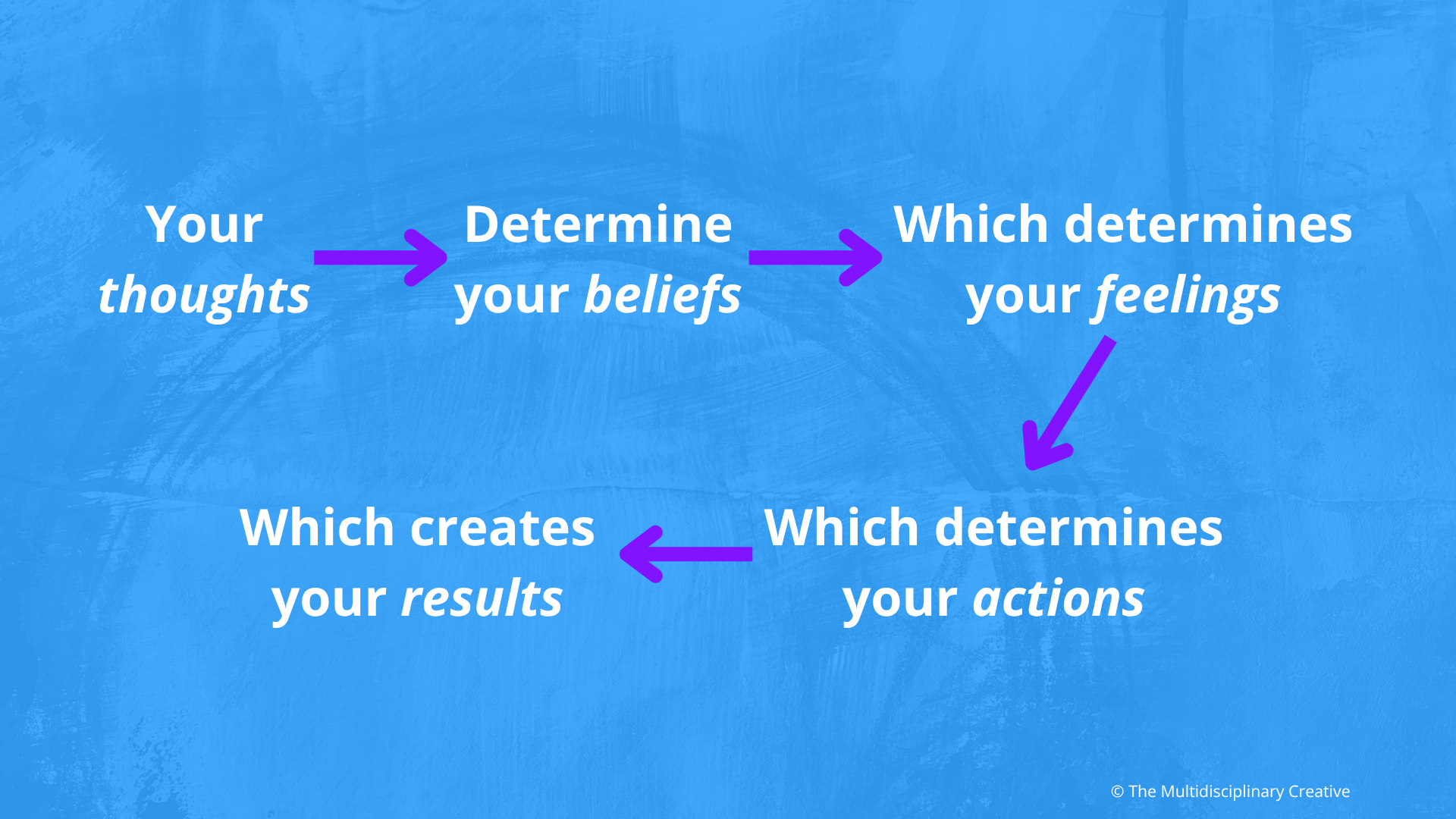
You’ll know that thoughts and beliefs are the root of everything, from the way we feel to the results we see in our work and lives.
In other words, if you’re not having the results you want with your creativity (whatever they may be), you need to explore the thoughts that you’re thinking and the beliefs that you have about your creativity, your work, and even the beliefs you have about yourself as an artivist that are holding you back from the results you want.
So, let’s first look at what a fixed mindset is.
Fixed Mindset
A fixed mindset is a belief system where individuals perceive that their abilities, intelligence, and innate talents are static and unchangeable. They believe that these aspects and characteristics can’t be improved on.
People with a fixed mindset tend to think that qualities like creativity, intelligence, and skill are inherent traits that they either have or don’t. They believe that success is based on being naturally gifted rather than on effort, practice, or learning (i.e., you were either born to be a painter or not, and if you don’t have any talents in painting, you won’t be able to paint very well).
Some of the characteristics of a fixed mindset are:
Avoidance of challenges
Seeing effort as meaningless
Giving up easily
Ignoring feedback
Feeling threatened by other people’s success
Etc.
For creatives, a fixed mindset can be especially limiting because creative work is inherently about growth and development in skills and expression. The more you paint, write, design, etc., the better you become at those skills. The more you express yourself creatively, the better you will become at expressing your artistic voice. But it’s difficult, if not impossible, to do that with a fixed mindset.
Additionally, if you believe that your creative abilities are “fixed” and can’t be improved upon, you may be less willing to take risks, experiment, or try new things. The result of that will be less growth, since taking risks, experimenting, and trying new things are usually where the growth happens. Having a fixed mindset that keeps you from experimenting means that you’re proving yourself right. It’s a self-fulfilling prophecy.
Example: Your thought (“you need talent to be creative”) determines your belief (“creative skills can’t be learned or improved upon”) → which determines your feelings (hopelessness, because there’s no point in trying or doing anything at all) → which determines your actions (doing nothing, because there’s no point) → which creates your results (nothing gets done).
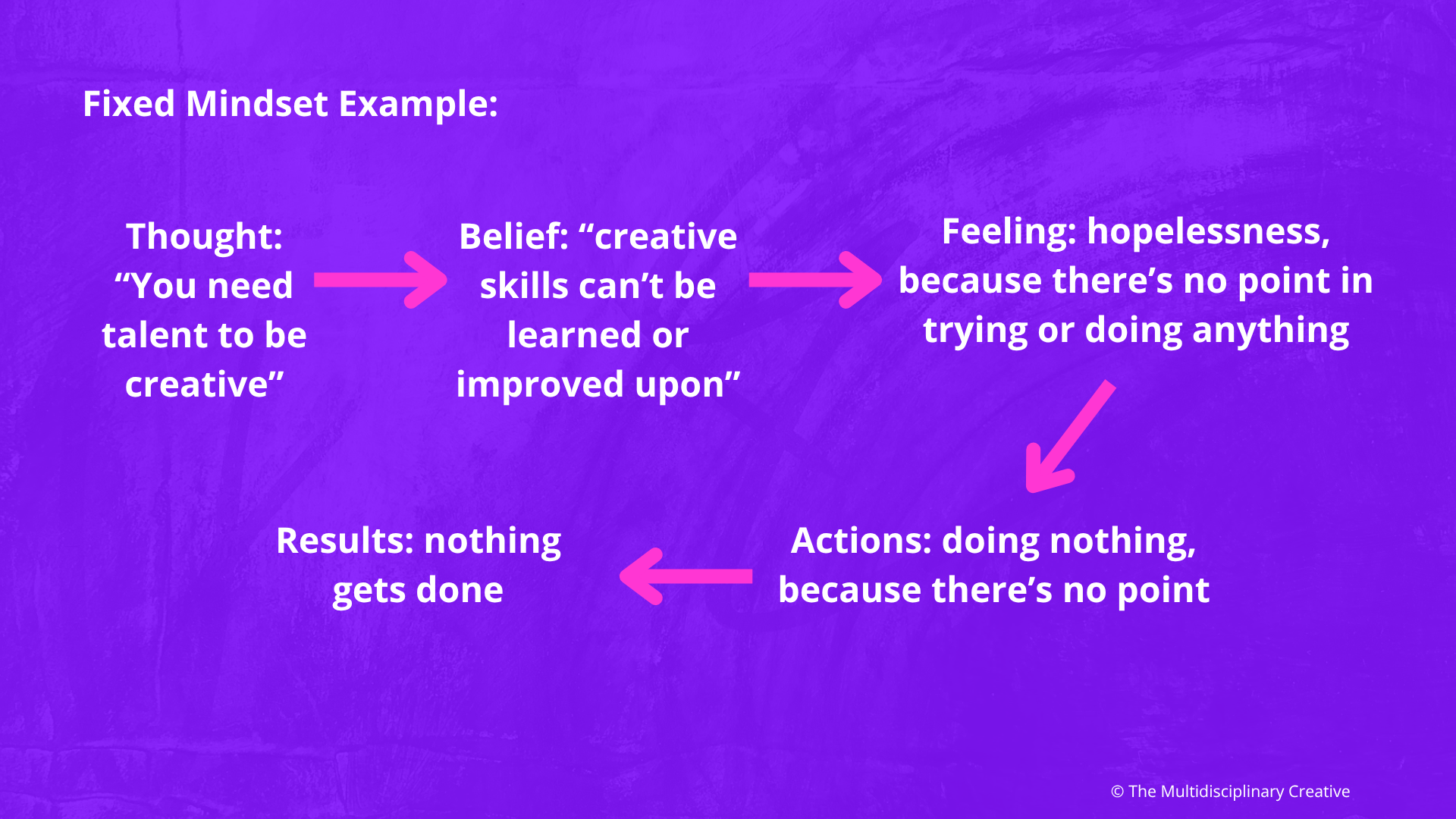
The important thing to ask yourself here is whether you want to be right or create your art.
Now, don’t worry if you resonate with some of these things, because we can shift a fixed mindset into a growth mindset.
But, before I get into some exercises, let’s first explore what a growth mindset is.
Growth Mindset
In contrast to the fixed mindset, having a growth mindset means that you believe you can improve your skills, capabilities, and the talents you were born with. Nothing is fixed. Nothing has to stay the same. If you want to become a better painter, writer, musician, filmmaker, etc., you can.
Those with growth mindsets tend to take risks, experiment, and try new things a lot more. Trying, “failing”, and trying again is a cycle you’re most likely more familiar with, perhaps even excited about, because you know that it will help you learn and grow. It will help you improve your creative skills, uncover your style and voice, make your work better each time, etc. And if you make something you don’t necessarily like, you know there’s a lesson in there about what not to do next time.
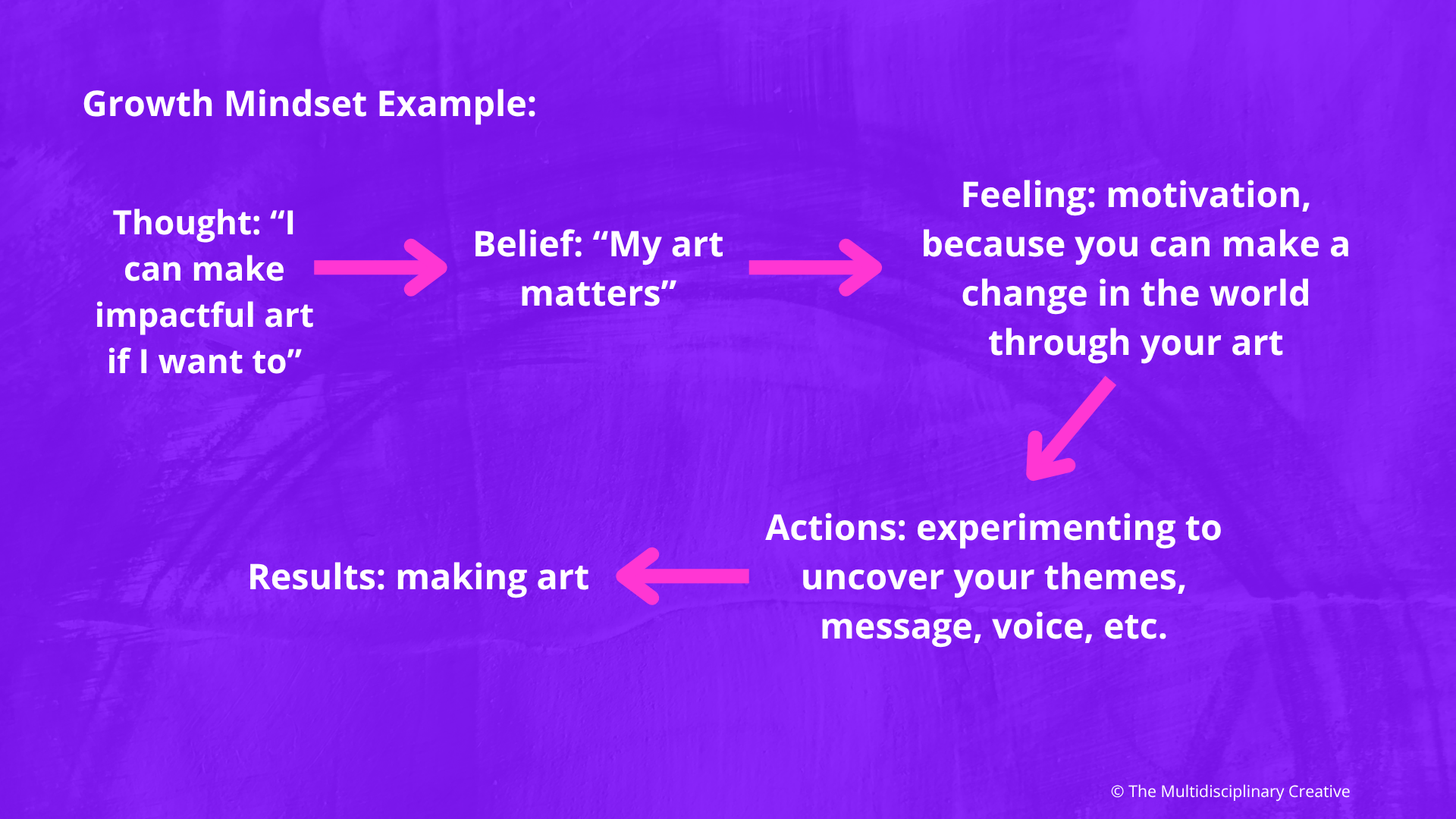
Example: Your thought (“I can make impactful art if I want to”) determines your belief (“my art matters”) → which determines your feelings (motivation, because you can make a change in the world through your art) → which determines your actions (experimenting to uncover your themes, message, voice, etc.) → which creates your results (making art).
If you want to learn more about the fixed and growth mindsets, I recommend reading Carol Dweck’s book Mindset: The New Psychology of Success, which is where the topic of the growth mindset was first introduced to the mainstream and where I first learned about it.
Before I get into some exercises, I also want to explore the topic of limiting beliefs.
Limiting Beliefs
Limiting beliefs are negative thought patterns or assumptions about ourselves, our creativity, and the world around us. These beliefs often come from past experiences, familial and/or societal influences, personal insecurities, or past failures.
While everyone has them to some degree, when left unchecked, they can significantly impact your ability to achieve success, particularly in creative fields where vulnerability, experimentation, and risk-taking are a part of everyday life.
Some of the characteristics of limiting beliefs are:
Perfectionism
Fear of failure
Self-sabotage
Fear of judgment and rejection
Self-doubt and a lack of confidence
Procrastination and lack of focus
Etc.
As you can see, limiting beliefs and fear are closely related, so if you haven’t gone through the previous part on self-sabotage (especially the section about fear), then I recommend you do that.
Now, let’s get into some exercises.
Exercises
Let’s look at your relationship with a fixed vs a growth mindset:
Do you resonate most with the fixed or the growth mindset? Why?
If you resonate most with the fixed mindset, how can you embrace more of the growth mindset?
If you’re unsure how to answer the previous question, here are some different ways you can explore the fixed vs growth mindset:
When you think about your skills, abilities, or talents, do you see them as things you have or things you can develop? Why?
When you make a mistake or fail at something, what does your inner voice/critic say? What does that reveal about your mindset?
Think back to when you last faced a challenge in your work. What’s the first story you told yourself when that happened? Was it something akin to “I can’t do this” or “I can learn how to do this”? Why do you think that was your default?
We will go deeper into limiting beliefs below, so I’m saving those exercises for later.
Now that we know a bit about what fixed and growth mindsets and limiting beliefs are, let’s look at how we can shift them to something that’s a lot more supportive and empowering.
Key Strategies for Shifting From a Fixed to a Growth Mindset
Let’s start with how to shift from a fixed to a growth mindset.
To do this, it’s important to start seeing challenges and “mistakes” or “failures” as opportunities to learn and improve.
Let’s look at a few key strategies:
Embrace challenges: Instead of avoiding difficult tasks, try to see them as opportunities to grow and expand your skills and abilities. If you, for example, feel stuck in a creative project, take a moment to reflect on possible solutions to that situation rather than just moving on to the next project.
Learn from “failure”: When something doesn’t go as planned, view it as a valuable lesson rather than a mistake or failure. If you, for example, overworked a painting to the point where you feel like it’s beyond repair, take a moment to reflect on possible lessons you can derive from that situation. You could ask yourself:
Where could you have stopped working on it?
Why did you choose to continue working on it?
And other such questions that will help you get to the root of why you got the result you now have and how you can avoid that next time.
Value progress over perfection: Celebrate small wins and improvements instead of expecting immediate, flawless results. Also, let it take its time. Don’t expect to have something great after just one day, or a week, or even a month (depending on the size of your work or project). Let it take the time it needs.
By adopting a growth mindset, you can build confidence, become more resilient, and ultimately unlock your full potential as an artivist. Doesn’t that sound great?
Exercises
Let’s dive into some exercises on your relationship to challenges and “failures”:
Do you embrace or feel uncomfortable when faced with challenges on your creative journey?
If you feel uncomfortable, how can you embrace challenges a little more and become more comfortable with them?
What kinds of challenges do you struggle with most? How can you view them differently?
How do you usually react to “failures” in your work or on your creative journey? Here are two contrasting examples:
Do you self-criticize? If so, why? How does that make you feel? What does it result in (i.e., self-sabotage, feeling stuck, not wanting to make any art, etc.)?
Do you see the “failures” as lessons? How does that make you feel? What does it result in (i.e., growth, confidence, more exploring and experimenting with your art, etc.)?
If you struggle to see the lessons in “failures” but want to learn how to better do it, here’s a simple exercise:
Think about a current or previous project or decision you made in your creative work that you think was a failure.
What’s one small tweak or change you’ll make in the next work or project? Or, another way to look at it: In this “failure” of a work or project, what did you learn not to do in the next one?
Note that it may take some practice to see the lessons objectively without any harsh self-criticism. But the more you practice, the easier it will get. Also, remind yourself of the other key strategies above as you move along on your creative journey.
To end on a more positive note: What are some recent small (or big) wins you’ve made on your creative journey or in your current/most recent project? Did you celebrate them? If not, how can you celebrate them?
Now, let’s look at some powerful mindset shifts.
Shifting Limiting Beliefs into More Empowering Alternatives
Let’s explore some common limiting beliefs that many artists and creatives struggle with (myself included), and how you can reframe them into more empowering alternatives.
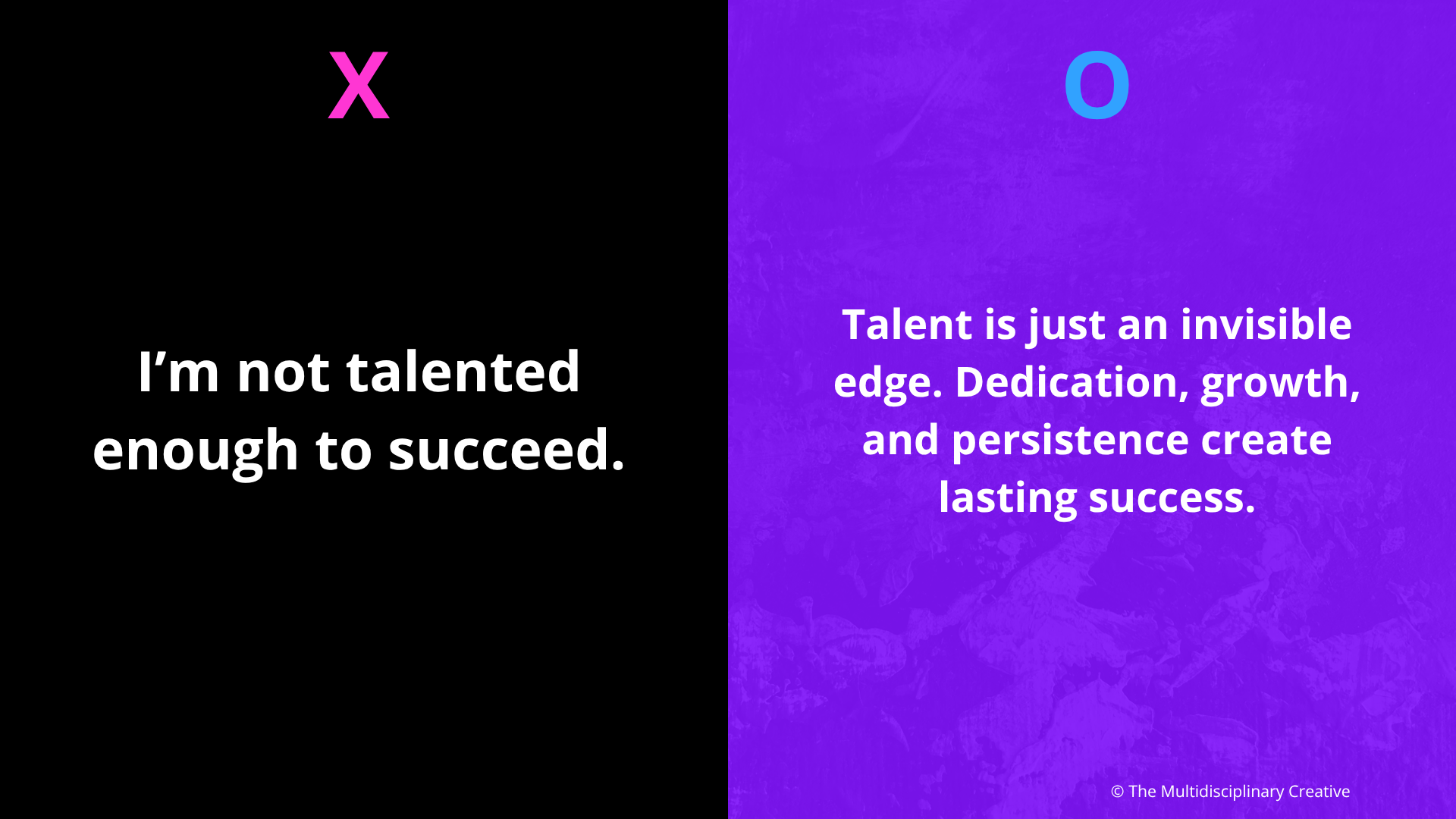
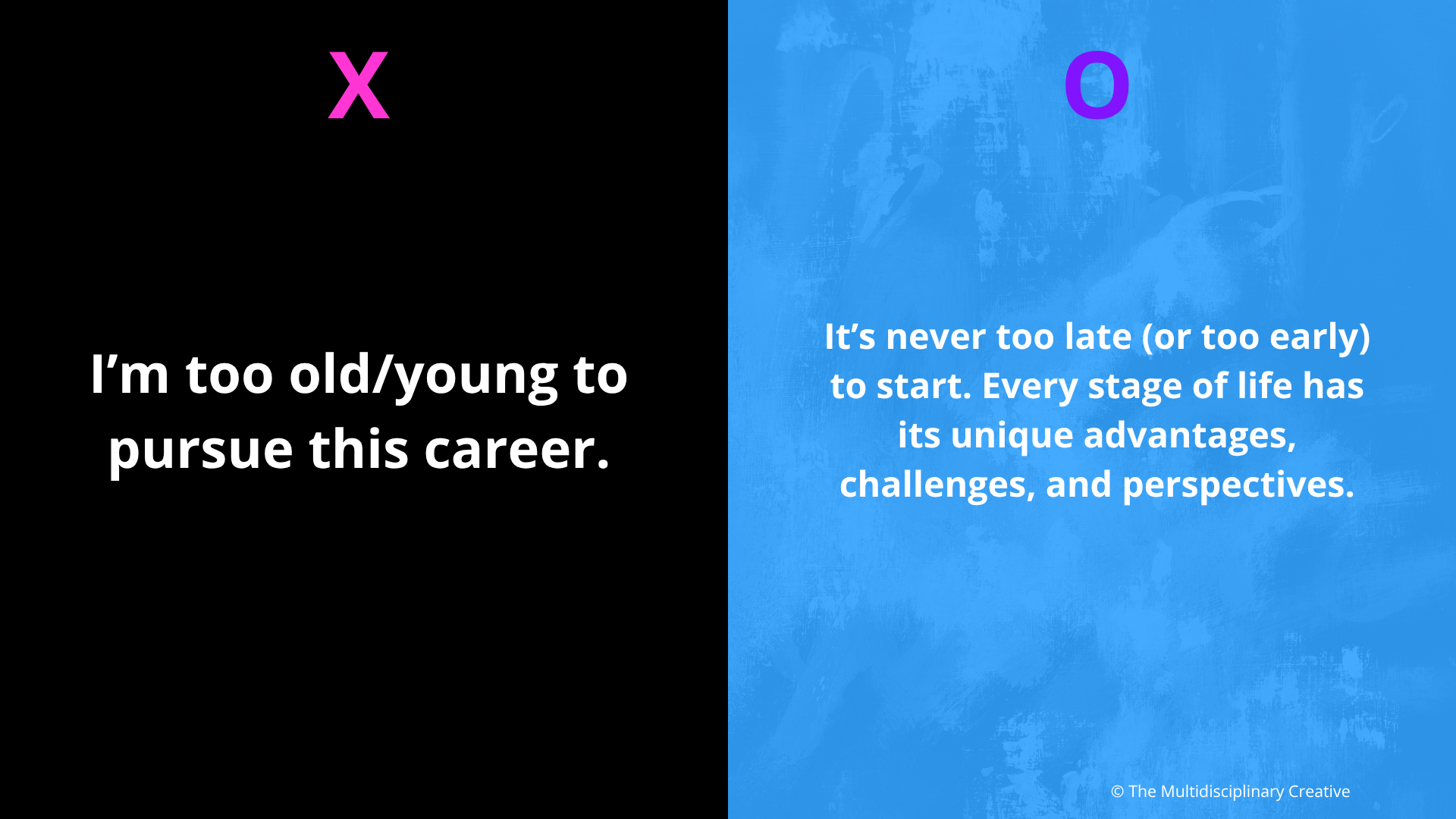
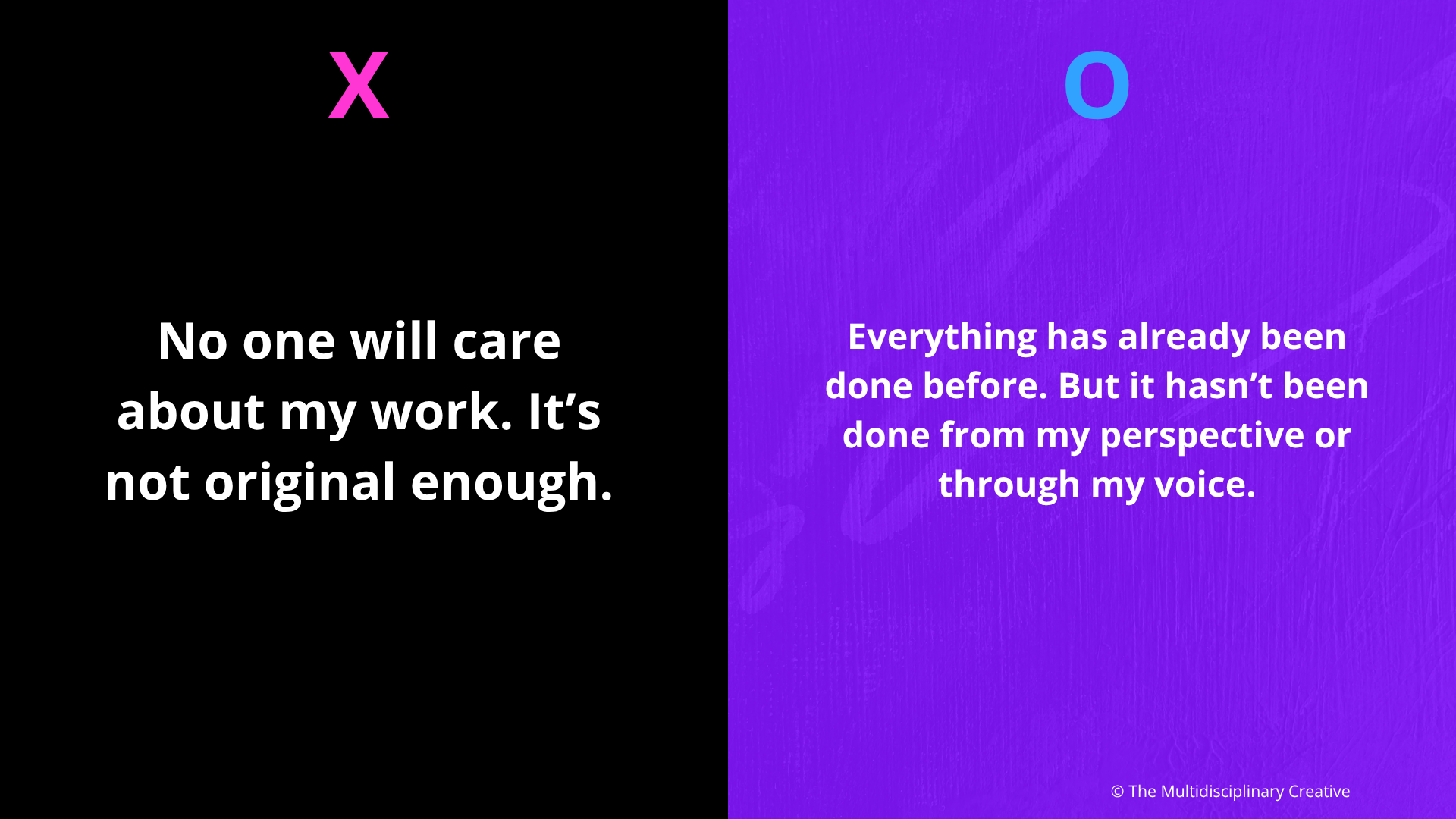
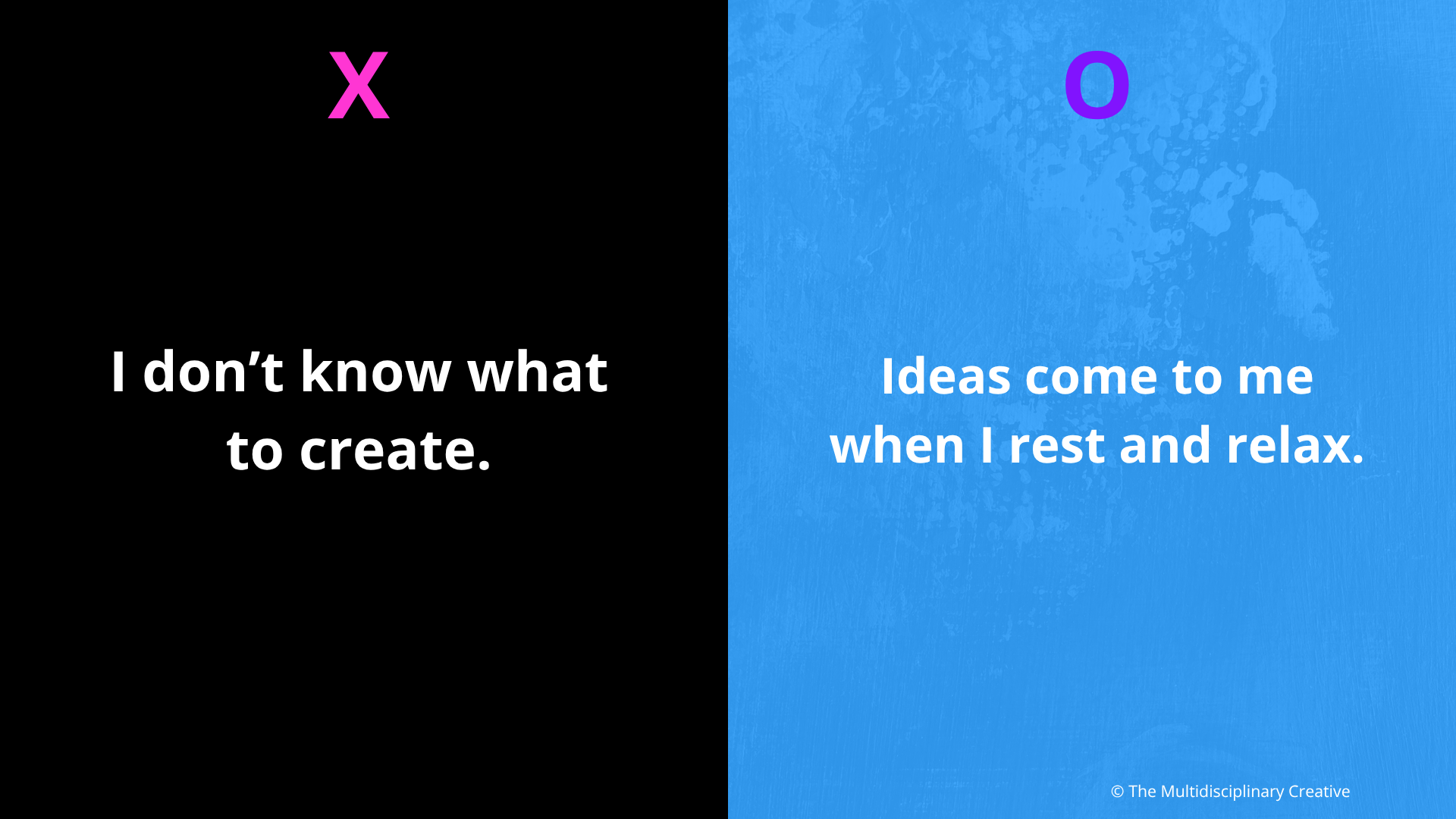
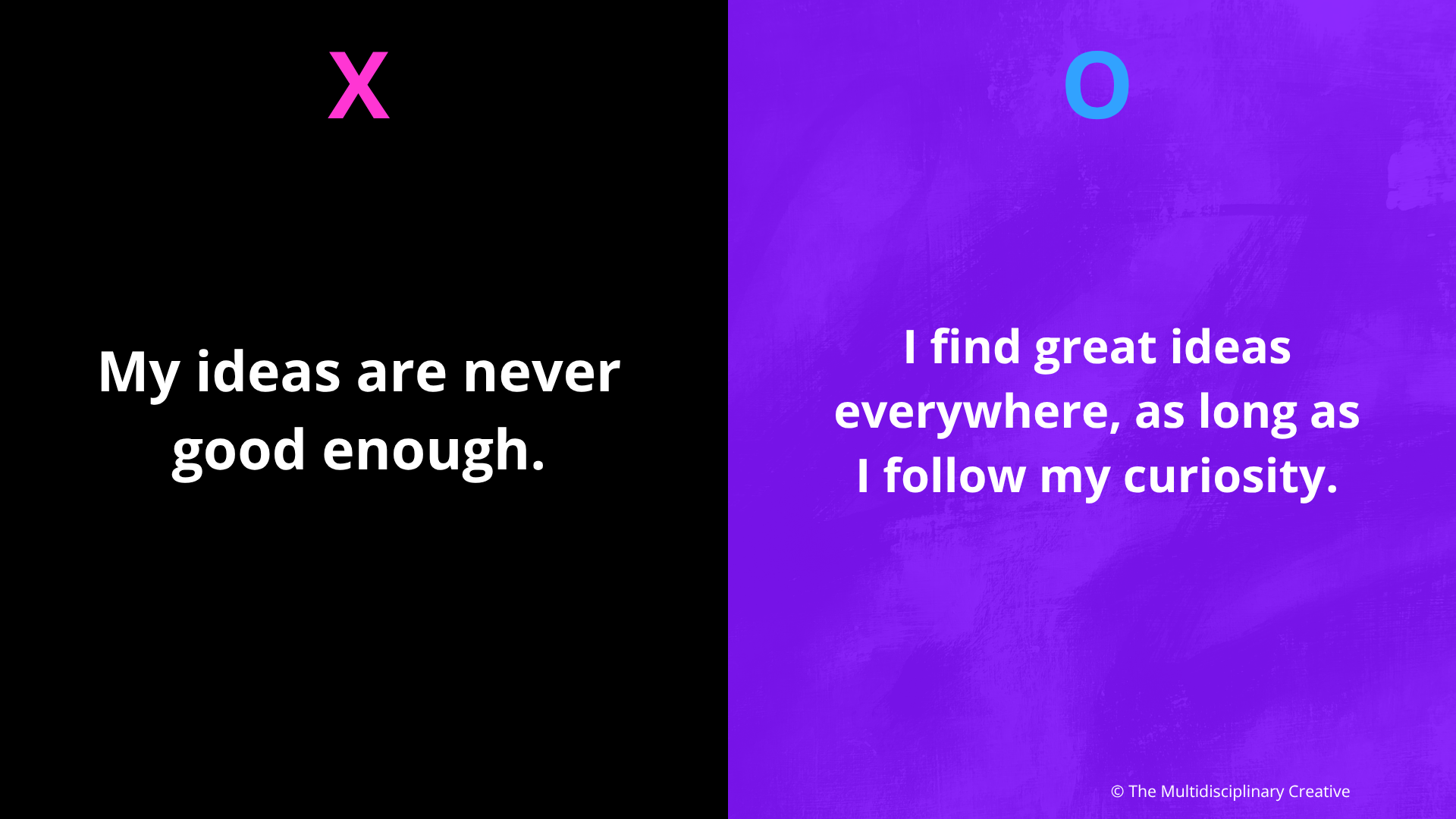
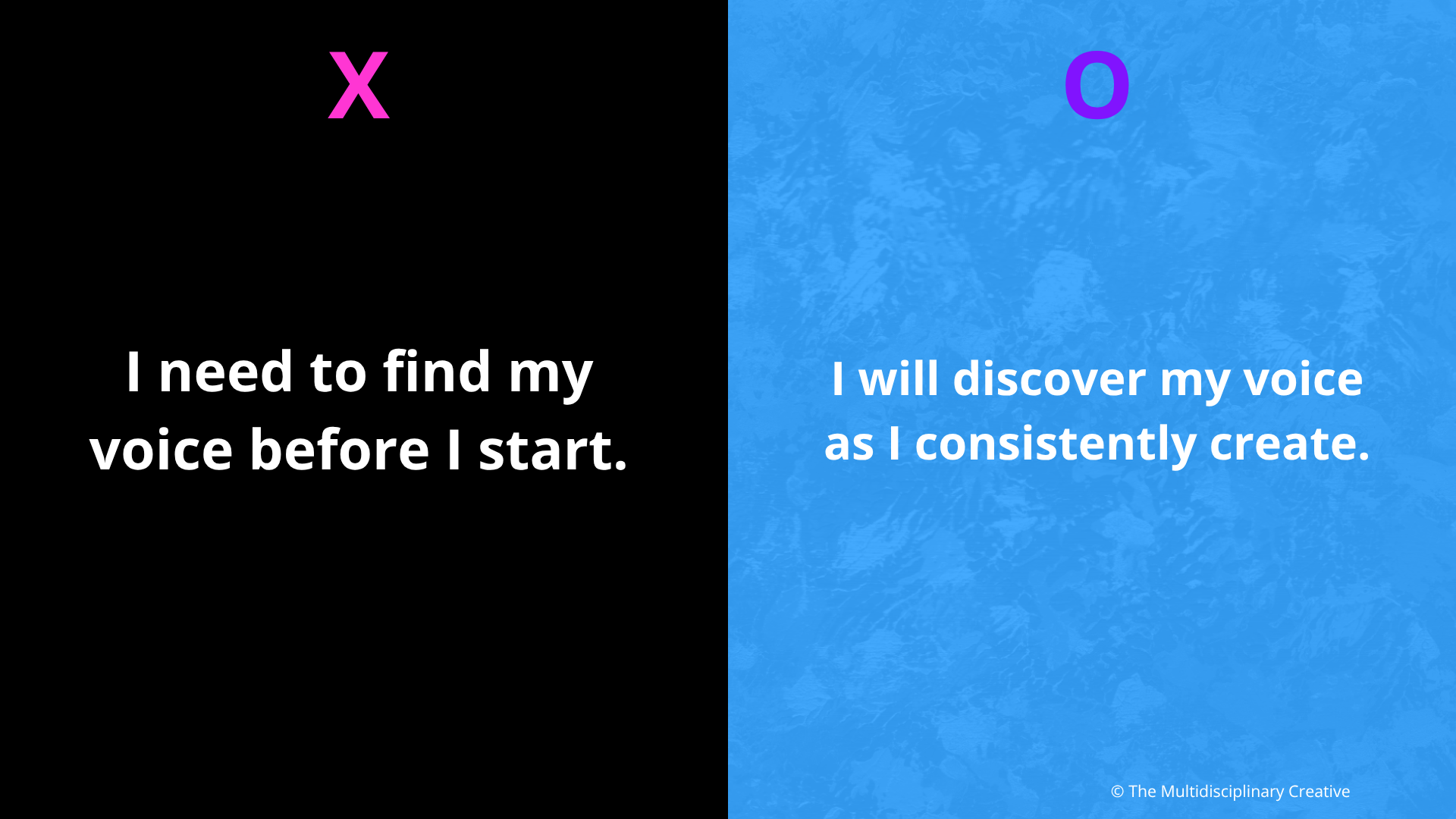
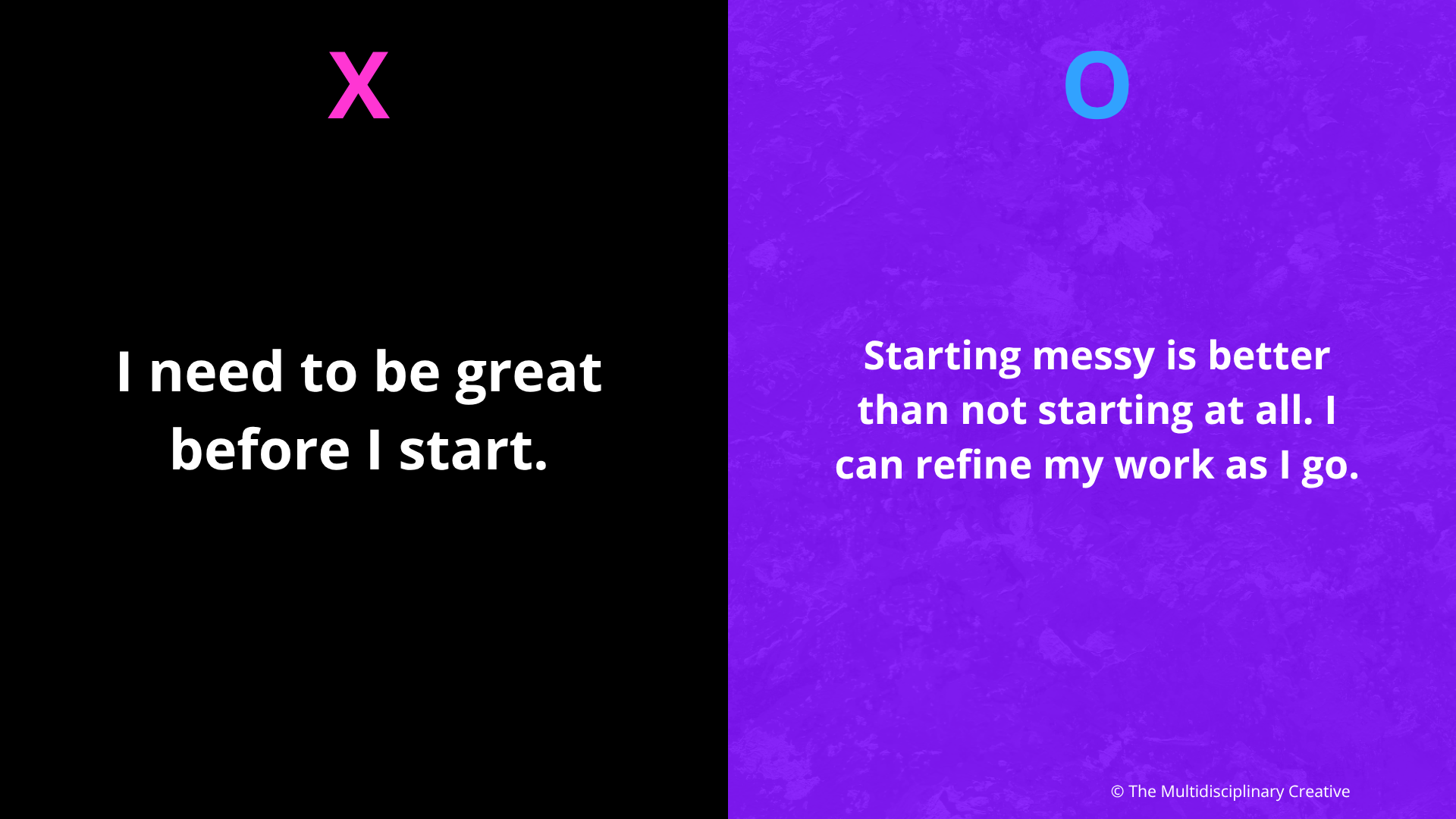
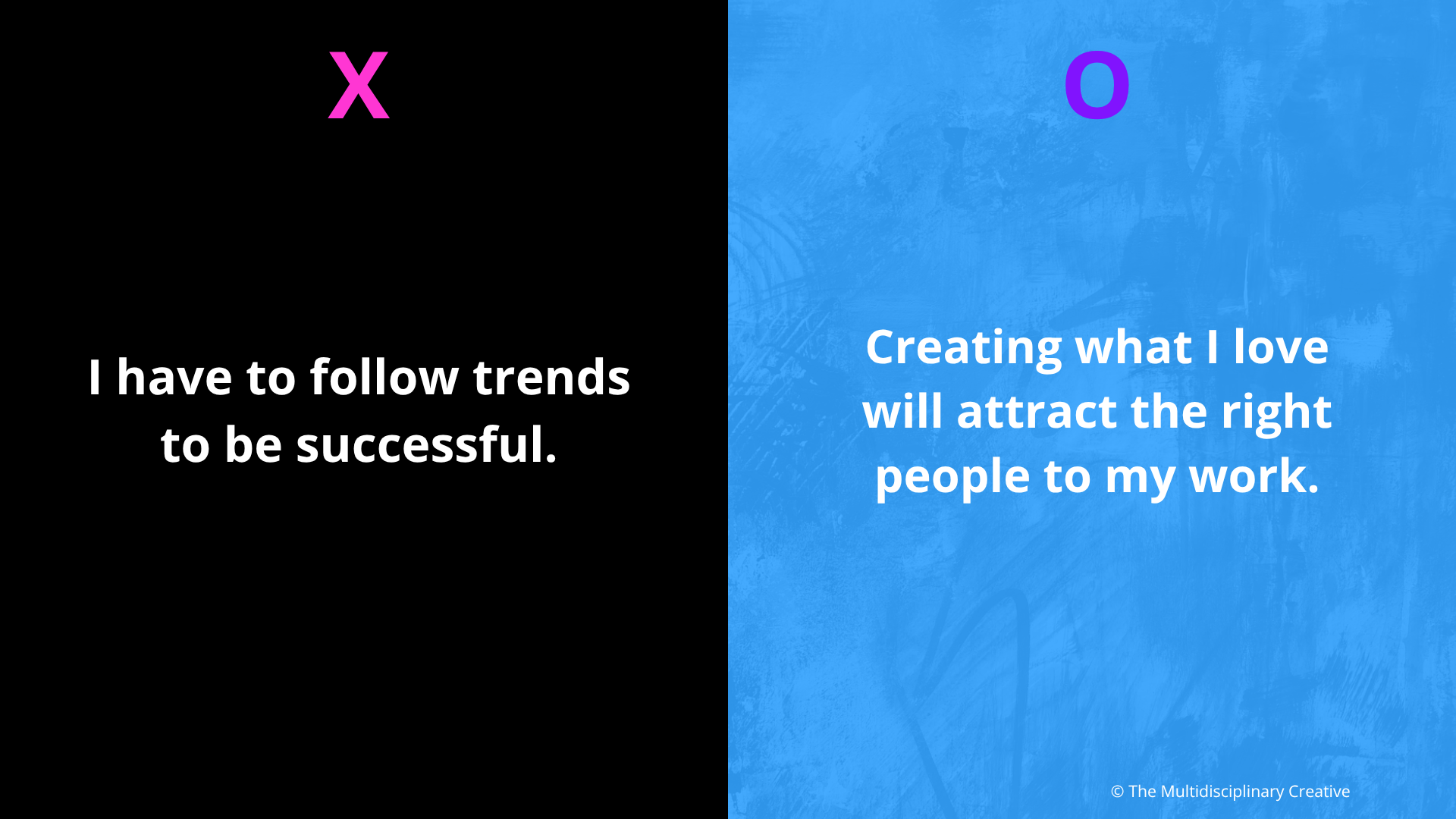
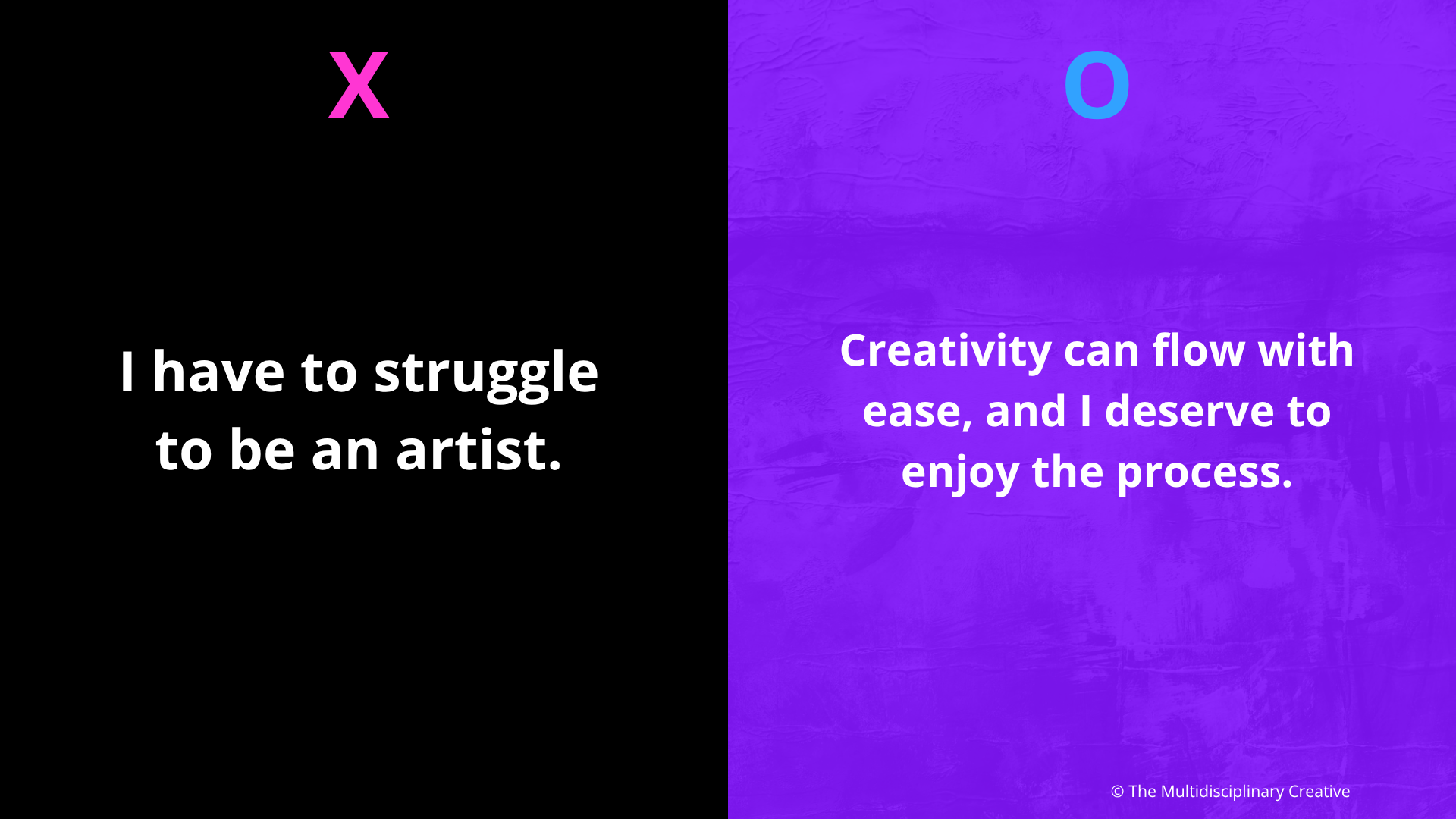
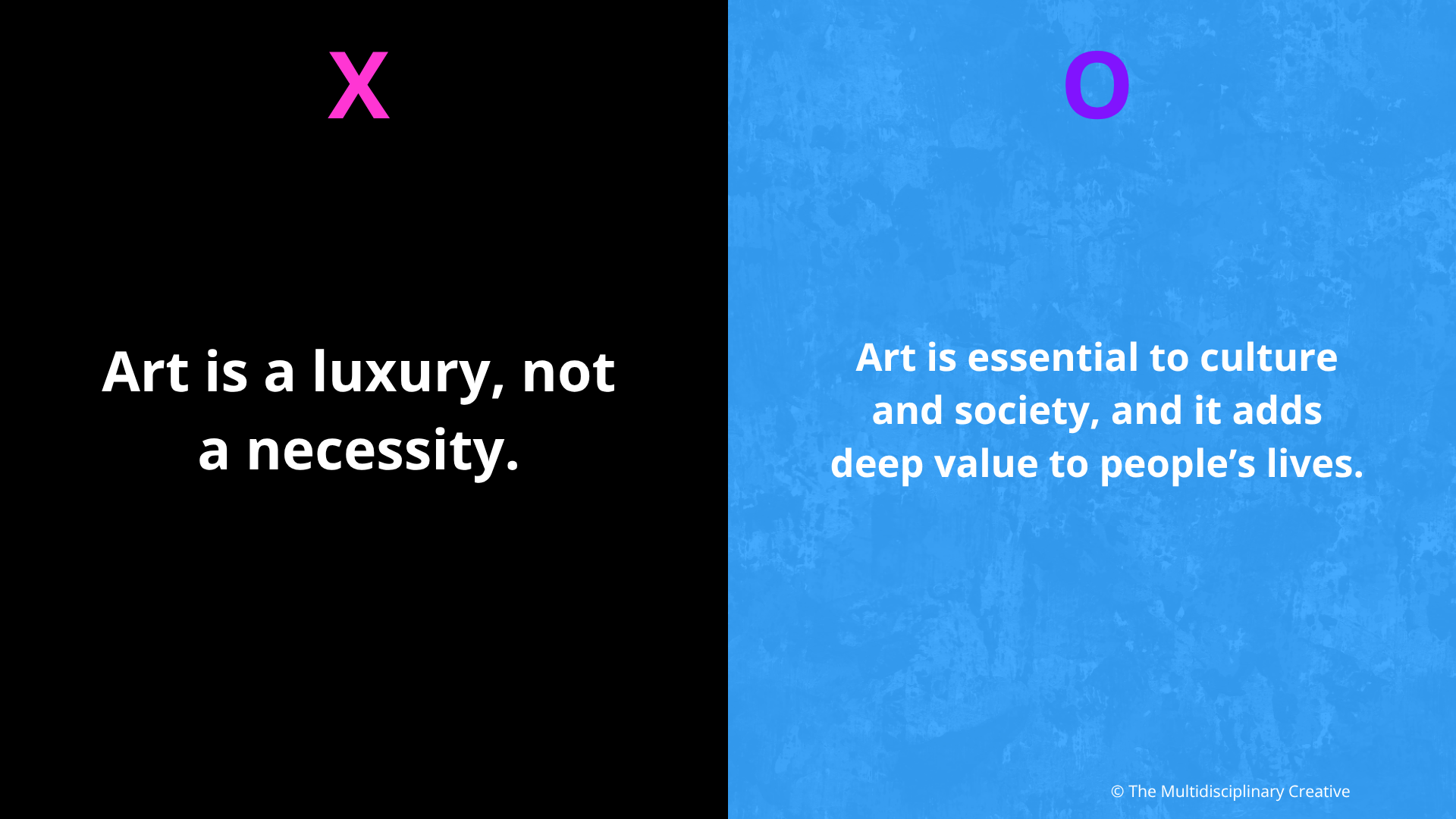
Don’t those empowering beliefs feel so much better? And the great thing about them is that you can use them, and others, every day to shift your beliefs.
I know that when I ask you to let go of those old, limiting beliefs that are holding you back, I’m making a big ask. I’m literally asking you to become the next-level version of yourself.
I know that this is no small deal because I’m asking you to shift into a whole new way of thinking and acting, and that’s not easy. However, shifting into these new beliefs is also what helps you step into your full potential.
The next level of you won’t allow self-sabotage to operate under the radar. Awareness of what’s going on and why you’re really holding yourself back from creating your art is key to realizing what you can do about it.
And that’s a major characteristic of a courageous artivist. The courageous artivist that I know you are.
Exercises
Here are some more practical tips on how to shift beliefs:
Do a brain dump of all the thoughts and limiting beliefs you have about your creativity and projects.
You can write it down in a list, in a mind map, or just wherever you want on the page. It doesn’t matter. All that matters is that you get it all out of your head and onto paper.
Make two columns on a new page and title one “Limiting Belief” and the other “Empowering Belief”.
Put everything from your brain dump into the column for limiting beliefs, then transform those beliefs into more empowering ones (similar to how I did in the images above).
Then go back and read your Empowering Beliefs and choose however many you want to use as affirmations when you notice self-doubt creeping in.
If you want to, you can place the Empowering Beliefs somewhere you’ll see them every day as a reminder of these new beliefs you want to adopt.
Part 3: Uncovering Your “Why”
Uncovering and knowing your “why” is essential for sustaining long-term creativity, purpose, and motivation. It’s the fuel for everything you do, it’s resilience building, and it will help you persevere through tough times. Knowing your “why” can also help you uncover the message you want your art to communicate and the kind of artivism you want to create.
In other words, knowing your “why” will help you get in touch with your internal motivation for your creative work, what you want that work to look like and communicate, and help you continue to create even when the journey isn’t only rainbows and unicorns.
If you know your “why”, and if it’s strong enough of a motivation for you, it doesn’t matter how you’re going to accomplish something. You’ll figure it out somehow because your “why” matters so much to you.
Knowing your “why” will also help you keep going when fears and limiting beliefs are trying to steer you in the wrong direction or hold you back.
Additionally, when you notice that something is holding you back, it may be an indication that reminding yourself of your “why” is needed.
But, how can we explore, uncover, and identify our “why”?
Uncovering Your “Why”
Finding your “why” is often a process of introspection, exploration, and experimentation. Here are some tips to help you discover your deeper motivations and purposes:
Reflect on What Moves You
Think about the moments or experiences in your life that have deeply impacted you:
What art, stories, or projects have had a lasting emotional effect on you?
What themes do you find yourself consistently drawn to in your creative work?
What causes and social issues and injustices are you drawn to?
Journaling or contemplating these questions can often reveal patterns that point to your “why”.
Identify Your Core Values
Ask yourself what matters most to you.
What do you want to stand for through your work? (i.e., freedom, connection, justice, awareness, healing, empowerment, etc.).
What causes and social issues and injustices do you want to bring awareness to? And what is the message you want your art to communicate in relation to those causes and social issues and injustices? Do they align with who you are and the message you want to communicate?
Articulating these values can serve as a guiding force in your creative practice, ensuring that your work reflects what is most important to you and what you want to bring awareness to.
Define Your Artistic Impact
Consider the impact you want your work to have on others and the society/culture/world at large.
Do you want to inspire, challenge perceptions, educate, evoke emotions, bring awareness to an issue, or something else?
Who do you want to reach?
What other goals do you have for your work and the impact you want to make in the world?
Think about the broader purpose of your work beyond just personal fulfillment. This can help you gain a sense of your “why” in relation to your family, your audience, community, and the world.
Experiment and Reflect
Sometimes, your “why” isn’t something that can be logically figured out, but something that you feel. And, sometimes the act of creating in itself can help clarify your “why”. As you experiment with different materials, media, and concepts, take time to reflect on how each experience resonates with you.
What does it feel like when you’re creating something that’s truly aligned with your deeper purpose?
Does a particular type of project bring you joy?
What subjects and themes do you enjoy and/or feel the most urgency working with?
Does one style, medium, or subject matter feel more authentic to you?
Your creative process can help you discover what feels most aligned with your “why”.
The “5 Whys” Technique
This is a simple but powerful method you can use to go deeper and uncover your “why”.
Start by asking, “Why do I create art?” Answer honestly, then ask, “Why is that important to me?”
Repeat this process at least five times, drilling down deeper with each answer. This often leads to a core motivation that’s clearer and more meaningful.
The deeper you go, the closer you’ll get to something that resonates with you.
Here are some additional prompts that may help you go deeper:
Why is [this particular cause or social issue and injustice] important to me?
What kind of impact can my creativity, projects, and/or career have on my life and the lives of the people I care about?
Why is it important to feel ___?
Why is it important to get/have ___?
One Major “Why”
Go back to look at your notes and the “whys” you’ve uncovered and explored. Highlight any points that stand out to you relating to your “why”.
Then I want you to select one major “why”. It can either be one you’ve already fully formed in the previous steps or a combination of different thoughts you’ve written down.
Write down your “why” on a piece of paper and keep it somewhere you can see it every day. This will allow you to tap into your “why” regularly, which may fuel your motivation and help you create something deeply meaningful (whatever that means to you).
Part 4: Building Creative Habits
Part of the reason for this ultimate guide about mindset for artivists has been to help you deal with resistance and possible creative blocks, which is something all creatives and artists struggle with. One simple way to deal with that is to build creative habits that will help you get into the creative flow without overthinking things too much.
Building creative habits is also essential for artists and creatives because creativity is like a muscle that needs regular exercise to stay strong. Unlike a one-time burst of inspiration, habitual creative practice helps you consistently engage with your work, your artivism, improves your skills over time, and fosters a mindset of continuous experimentation and exploration.
Let’s begin by looking at some reasons why it's important to build creative habits before I give you some tips on how to do it.
Why It’s Important to Build Creative Habits
Consistency Equals Growth
The first reason building creative habits is so important is that consistency equals growth.
You're setting yourself up for incremental improvement by building regular creative habits. Even when you don’t feel particularly inspired, consistent practice keeps the creative process moving forward, you build momentum, and you continue to hone your skills.
Even if it’s just a 5 or 10-minute sketch, a 5-sentence paragraph, or 2 rows of stitches on your knitting project, you’ve still used your right brain for something creative that day. And that’s better than nothing.
Develops Discipline
Another positive result of building creative habits is that it cultivates discipline.
Even though I might not value discipline as the most important quality of a professional artist and creative (because I believe self-forgiveness is much more vital), discipline is still important.
The discipline of showing up to your creative practice, even when motivation is low, can be just as valuable as the creative output itself. Discipline can help you move through creative blocks, deadlines, and whenever inspiration is fleeting or hiding somewhere.
If you feel like you’re lacking in the discipline department, it might be a good idea to look at possible distractions in your life and evaluate them, which I’ll get into in a bit.
Generates New Ideas
Another positive effect of creative habits is that they generate new ideas.
If you’ve ever gained new ideas when working on a project, whether that’s ideas for your current project or ideas for other ones, you know what I mean by this.
The more you practice and expose yourself to different techniques and ways of thinking, the more ideas you will generate. Consistent creative work helps you tap into deeper layers of your imagination and allows new ideas to emerge more naturally.
I’ve also noticed that doing something creative in one discipline gives me new ideas in others. I remember one time a couple of years ago when I was stuck in a story I was writing, and had been stuck for over a week at that point. But as soon as I stopped glaring at my screen and picked up my crocheting project, ideas on how to change the story to make it more exciting for me to work on started to emerge organically.
So, if you feel stuck in one project, you can try doing something else creative and take note of what ideas come up.
Reduces the Pressure of Perfection
The final positive effect of creative habits that I want to mention here is that they reduce the pressure of creating perfection.
When creativity becomes a consistent, regular, low-pressure habit, it allows you to focus more on the process of creating rather than on creating a perfect piece of work.
I’ve also found that, when I focus on the process rather than the outcome, I create things wouldn’t even have thought about in the first place. Not that all those things are great (or even good), but there’s always something I can take away from that experience, whether it’s a technique I want to continue exploring, or a description I love that came out of nowhere, or a color combination I like, or something else.
In other words, building creative habits has several great benefits.
Now, let’s look at how we can build creative habits so that we can gain these benefits.
How to Build Creative Habits
Start Small and Be Consistent
The first tip is to start small to build consistency. This is especially important if you haven’t used your creative muscles consistently for some time or are feeling blocked.
Experiencing creative blocks isn’t always a dead end. Sometimes, it’s a sign that your creativity is evolving, stretching, or unlocking something new. When you're in the middle of it, however, it can feel frustrating, like you're staring at a blank page or canvas, second-guessing every idea, and waiting for inspiration that never comes. Starting with something small and being consistent can be very helpful here.
You can begin as small as 10-15 minutes a day. Over time, this builds momentum and becomes part of your routine.
You could also set aside a specific time each day for your creative practice to help you build consistency. If you, for example, want to dedicate your time after breakfast to your creativity, you know that it’s time to be creative as soon as you’ve had breakfast.
Small actions are easier to maintain in the beginning, and consistency is key to making creative work a habit. As you get into it more, you can gradually increase the time to 30 minutes, an hour, or however long you want.
Here are some questions you can ask yourself if you want to start small and build momentum:
What’s a small creative habit you can start with today?
When are you usually most creative? (Morning, after lunch, at night, etc.) Can you set aside some time there to focus on your creative practice? If so, how much time are you aiming for right now?
Create a Dedicated Space for Creativity
The second tip is to set up a dedicated space for your creative work. If you already have a studio, a corner in your living room, a desk, or something else, that’s great. If you don’t, then this tip is for you.
A dedicated space signals to your brain that it's time to shift into creative mode. It can help condition you to enter the right mindset before you begin your work.
What your space looks like is entirely up to you. I recommend surrounding yourself with things that inspire you and your creative work. It can be certain items, images, inspirational quotes, or something else.
Years ago, when I focused on fiction writing, I had an old typewriter I'd gotten from my grandfather on my desk next to me. I never used it, but it reminded me of my love for writing. Nowadays, I have two corkboards where I change the images pinned on them every three months or so to get a new, fresh, and inspiring energy into my space. It's a small thing to do, but it helps me a lot.
If you prefer to have a minimalist setup, then do that. Whatever works for you to be as creative and focused as you can be is the right choice for you.
Here are some questions you can ask yourself to optimize your creative space:
Do you have a dedicated space for your creative work? If not, where can you create a space for yourself?
Perhaps it would be better if you changed your space? If so, where to? What makes the new space better than your current one?
How can you make your space as inspiring as possible? Are there any items, images, inspirational quotes, or something else you want to include in your space? Are there things you need to remove from your current space?
You might need to test out a few different places and setups before you find one (or a few) that works for you. Just remember to do what works for you.
Make Your Practice Into a Ritual
The third tip I have is to make your creative practice into a ritual rather than just a task to check off your daily to-do list.
This might mean that you start your practice with something that gets you into the creative flow, like a right-brain exercise, lighting a candle and setting an intention for your daily practice, or even a physical activity like stretching before you start working. It can also be something as simple as making a mug with your favorite hot beverage or putting on your favorite music. It might also be a combination of things like these.
Either way, rituals can help signal to your mind that it’s time for creativity, which is always a great start. The familiarity and comfort of a ritual can also ease the resistance that sometimes arises when you want to do something creative.
Here are some questions you can ask yourself to help you make your practice into a ritual:
If you don’t already treat your creative practice as a ritual, how can you turn it into one?
What do you like to do before you start your creative work? (Stretch, put on music, light a candle, etc.)
What kind of ritual would inspire and motivate you? Is there a particular poem that gets you inspired to write, a song that makes you motivated to paint, a photo or image that reminds you of why you’re an artivist?
If you want to, you can test out different kinds of rituals and evaluate after some time to see which one worked best for you. Perhaps you realize that it all depends on the mood you’re in on any given day and that you need to adapt your ritual after that, which is a great insight to have as well.
Just remember to only do what works for you.
Track Your Progress
The fourth tip I have is to track your progress. You can keep a journal or logbook to do this. It could include daily reflections, sketches, or notes about what you worked on and what you learned.
At the end of the week or month, look back on the entries in your journal to see possible patterns and growth. After some time doing this, you will see just how much you’ve developed and the progress you’ve made, which is always a great boost for your confidence.
Tracking your progress also allows you to reflect on what’s working in your process and your projects, what’s not working, and where you might need to make adjustments.
Here are some questions you can ask yourself to help you track your progress:
How do you want to track your progress? (Journal, daily diary, voice memos on your phone, etc.)
What do you want to include in your entries? (Sketches, reflections, lessons learned, etc.) Or, perhaps it depends on the day or the project you’re working on?
When or how often will you review your journal and evaluate your progress?
Embrace Play and Experimentation
The next tip is to embrace play and experimentation. Even though making art for social change often means that we have a specific reason for working on a project or making an artwork, making something without expectations or specific goals from time to time can also help you fight perfectionism, possible resistance, and feelings of being stuck.
This is also a great tip if you want to explore another medium, topic, movement, or something else. Test it out for a couple of days and see if it’s something you want to do. With this intention, there’s no pressure.
And if you create ugly art in the process, that’s okay. You can actually use ugly art on purpose by making ugly art for experimentation and exploration. Making ugly art it’s actually very rewarding because testing something new, experimenting, and playing can be the foundation for creative breakthroughs and do wonders for your creativity.
Here are some questions you can ask yourself to embrace more play and experimentation in your practice:
Do you want to play and experiment more? Why?
How can you create a habit around experimentation and play? How can you fit it into your creative process? When can you fit play and experimentation into your daily or weekly schedule?
If you’re not sure what’s play or fun to you, make a list of things you’re curious about when it comes to your creativity, practice, discipline(s), media, materials, techniques, subject matters, etc., and then spend some time experimenting and exploring that. Then note what you thought was most fun and do more of that whenever you feel like bringing more play and experimentation into your practice.
Notice and Get Rid of Distractions
Distraction kills creativity; therefore, the next tip is to notice your distractions and eliminate them.
I believe that dealing with distractions is one of the biggest challenges for full-time artists and creatives, especially when you’re working from home or in an environment that’s not entirely dedicated to your craft. Distractions can derail focus, creativity, and productivity.
Luckily, we can deal with distractions by becoming aware of them and then setting specific boundaries around them.
If you, for example, notice that your phone is a distraction, keep it in a separate room or somewhere where you can’t see it while you’re working. You can also tell your loved ones that they won’t be able to contact you between these specific hours while you’re working.
The key is to be self-aware. By understanding what derails your focus, you can proactively address those specific distractions before they take too much time from your creative work.
Here is an exercise you can use that can help you notice and eliminate your distractions:
Dedicate a page in a journal to writing a list of the ways that you distract yourself. It can be anything from your phone to your environment to procrastination, and everything in between. Update this page for a couple of days or a week.
Remember not to judge yourself. This isn’t a list of all the ways you’re lacking, because you don’t (we are all distracted at times). This is a list to make you aware of your distractions so you can do something about them and, in turn, prioritize your creative habits.
Once you identify your distractions, what kind of boundaries and strategies can you put in place to deal with them? (Leaving your phone in another room, setting a timer for focused work, working in a quieter location, etc.).
Build a Support System
The final tip I have is to build a support system.
Surround yourself with other creatives or like-spirited people who are also committed to their work. They don’t necessarily have to be artivists or make artivism, though, that could be an advantage since you may understand and be able to relate to each other’s struggles, worries, and wins more deeply.
I know it’s easier said than done to build a support system, but we also have the internet at our disposal nowadays, so it doesn’t have to be very difficult.
You can find a community of like-spirited creatives, artists, and artivists through social media, online communities, and programs. If you like real-life communities more, you can take creative courses available in your local area, arrange meetups with people you’ve met online, join organizations or movements that bring awareness to the social issues you want to work with, etc.
One important thing about support systems is that you’ll feel less alone. You can share your progress, discuss challenges, and get inspiration from others. Another upside is that it can provide you with accountability to keep your creative habits going. Plus, seeing other creatives do their work can be motivating and inspiring in itself.
Here are some questions you can ask yourself to build your own support system:
What kind of support system would you like to have? Who would you like to include in your support system? How can you reach out to them?
Where could you meet other artists and like-spirited creatives and artivists? (Whether in real life or online.)
What could you contribute to the support group? Remember that this is a give-and-take relationship.
It may take some time and trial and error to build a support system. But finding the people you click and vibe with is worth it.
Final Words
I hope this ultimate guide has helped you deal with some of the most common limiting beliefs, blocks, or resistance (or whatever you want to call them) that are common for artists and creatives.
You can come back to this post any time you’re feeling any type of block and cherry-pick what you need at the time.
Join the MDC email list to get news, peeks behind the scenes, and other things I only share in email right into your inbox.
